bufan528 / dsh-longterm-memory
DSH Memory Vault (长期记忆) — durable local long-term memory for DeepSeek Harness, stored as an Obsidian-compatible Markdown vault with a rebuildable index, an in-sidebar management page, and real per-turn recall.
About this plugin
Written by the registry from verified metadata, not from the README.
dsh-longterm-memory is a DSH plugin published from the bufan528/dsh-longterm-memory repository.
Capabilities and topics
Project status (2026-11-21).
0.3.0is published on npm and attached to the latest GitHub Release (with a version-agnosticdsh-longterm-memory.tgzasset). It adds DSH Go native support — 3 native panels, a composer strip, 9 native tool-result cards and a touch-adapted web page — on top of the 0.2.0 feature set. See What's new and DSH Go. The plugin is listed in two community registries: the DSH Plugin Market (added 2026-10-19) and the dsh.works community registry (dshworks/awesome-dsh-plugins, verified, added 2026-10-19). The in-app 插件市场 / Plugin Market is the dshmarket plugin and reads that same catalog, so the plugin is discoverable and one-click installable there as well (no separate submission). Install it from the in-app market, or from npm withdsh plugin add dsh-longterm-memory@latest. The desktop-app plugin entry is verified end-to-end in the running desktop app (61/61 real-browser checks over the five pre-existing tabs, real vault, restored afterwards; the 0.1.5 QQ tab was verified separately on an isolated 0.2.1-rc.3 host, see docs/evidence/qq-verification.md). See Install, What's new and Project status & limitations.
What's new
0.2.0 is a breaking release: the management page gains a first-level tab (伙伴中心 / Companion
centre) with eight panes — seven tabs in total — the RPC surface grows from 50 to 59 methods, and
the model gets five action tools alongside the four memory tools. Stickers, reminders and persona documents become
vault-owned files (Companion/, Reminders/), each with its own delivery rhythm; persona
evolution is queued for review and undoable; and the Owner gate gains an opt-in local-session
switch so a desktop install can read its own memory. Stored files remain compatible — only the
surface grew. See CHANGELOG.md for the full list and the four bugs found by
round-trip verification.
0.1.8 removes an experimental QQ message-merge control surface from the QQ tab. The tab is back to what this plugin owns: connection status, memory-linkage policy, session isolation, inbox wiring, diagnostics and security. No other behaviour changes; existing memory data, index, tools, prompt injection and all other tabs are untouched.
0.1.5 adds a sixth tab, QQ integration
(记忆总览 | 记忆检索 | 记忆管理 | 收件箱 | QQ 接入 | 设置), plus an optional
QQ ↔ long-term-memory linkage policy (three modes, four enforcement points) and a
diagnostics card. It is documented in docs/qq-integration.md.
The existing 61-check real-browser E2E suite still covers the five pre-existing tabs;
the QQ tab was verified on an isolated 0.2.1-rc.3 host (see
docs/evidence/qq-verification.md).
0.1.4 is a documentation release: the plugin is now listed in the DSH Plugin
Market (added 2026-10-19) and in the dsh.works community registry
(dshworks/awesome-dsh-plugins, verified; it powers the 插件 → DSH 社区 market in
the dsh-armory dashboard). Install or
update from the in-app 插件市场 / Plugin Market, or from npm. No code changes; it
ships all of the 0.1.3 fixes below.
0.1.3 made the Inbox actionable and fixed three other user-facing bugs:
- Inbox is actionable. 确认入库 / Confirm and 拒绝 / Reject now work for
in-memory candidates. Confirming writes an active memory (
lowconfidence is raised tomedium), folds a duplicate/supplement into the existing memory instead of duplicating it, and keeps both sides of a contradiction. Rejecting writes no file. - Status changes on extracted memories work. A multi-line
evidence:block scalar no longer blocks saves withunsafe-edit. - The UI language setting works (it previously lost to the host locale).
- No more permanent "unsaved changes" hint on the settings page.
- New real-browser E2E suite (
npm run verify:e2e) covering all five tabs, including the Inbox, detail, settings, batch and merge flows.
Full details: CHANGELOG.md · latest release
Why DSH Memory Vault?
Most "agent memory" features are a vector store or a black-box service. DSH Memory Vault makes the opposite trade-off:
- Markdown is the only source of truth. Each memory is a human-readable note with YAML frontmatter. Read, edit, link and back it up in Obsidian or any text editor. There is no proprietary format and no export step.
- The index is disposable.
.dsh-memory/index.jsonis derived data; delete it and the plugin rebuilds it from Markdown. Losing the index never loses a memory. - Recall is budgeted and transparent. Injection is computed per assembly from the current index with explicit token/item caps; the page shows exactly what the model would receive.
- History is durable. Every change is recorded in a journal with before/after digests, reasons and timestamps. A write-ahead outbox keeps history safe across crashes — including the verified window where the Markdown is committed but the journal append has not happened yet.
- Local by default. No network requests, no model calls, no telemetry; the only traffic is the local RPC between the management page and the DSH host.
Features
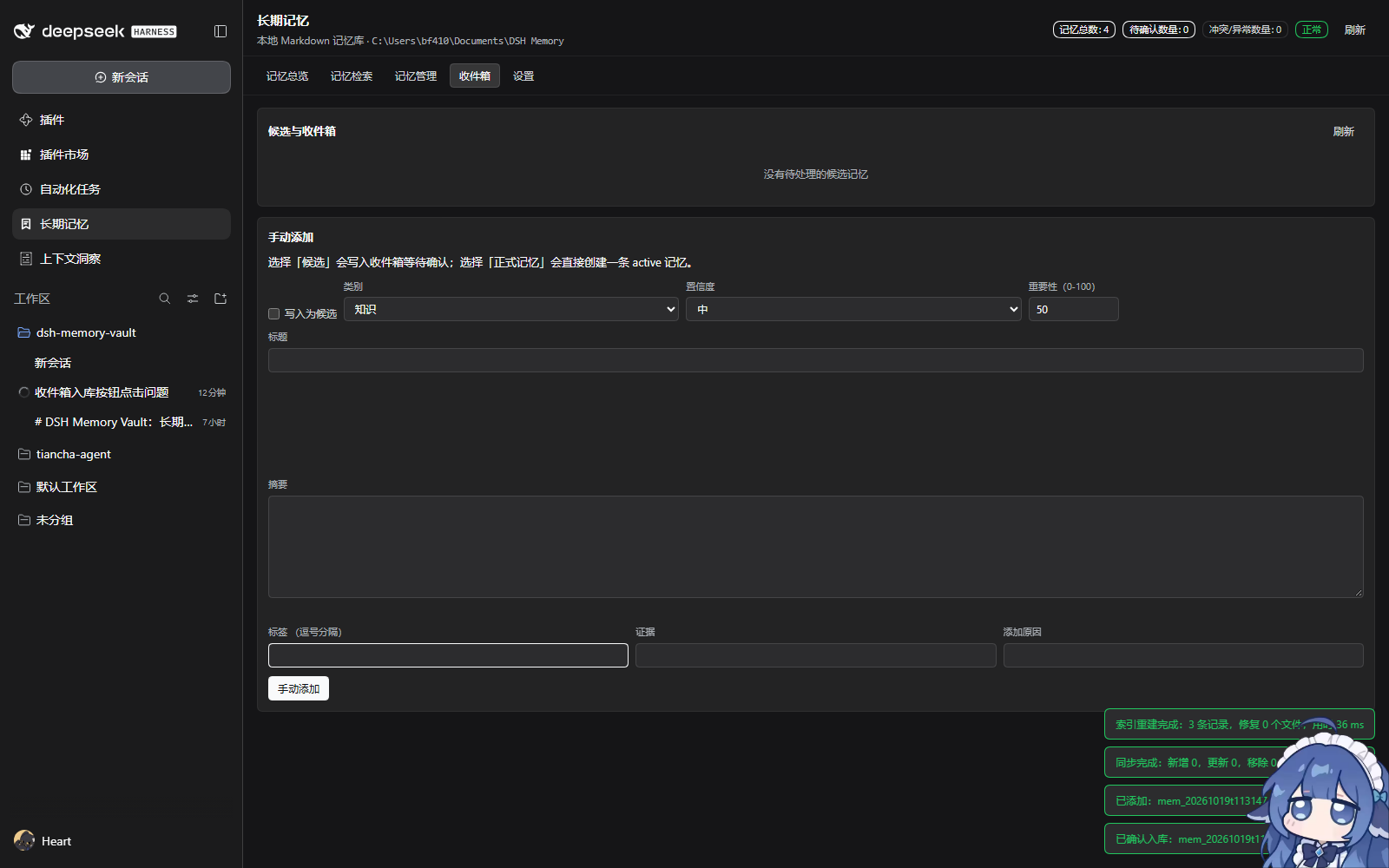
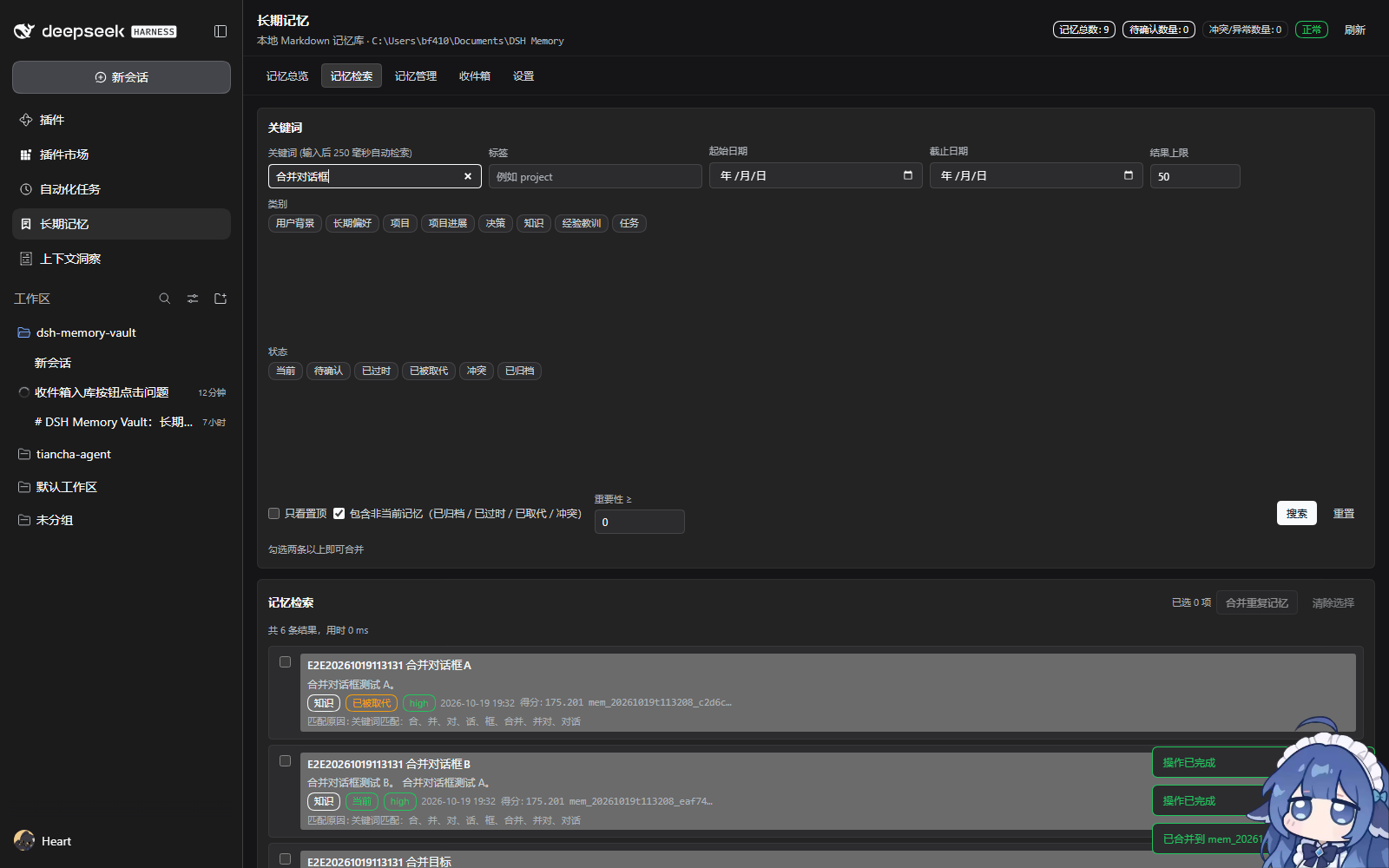
| First-level sidebar page | Registers a sidebar.panellist entry and a full management page (overview / search / manage / inbox / QQ integration / companion centre / settings) — not a chat tab. |
| Nine model tools | Memory: memory_search, memory_get, memory_save, memory_forget (save refuses credential-like content). Life: sticker_pick, sticker_ingest, reminder_create, reminder_list, reminder_complete. |
| Automatic extraction | Rule-based, fully local candidate extraction at the real turn/end boundary. Optional model-assisted extraction is off by default. |
| Ranked recall | BM25-style lexical ranking over Markdown, with type/status/tag filters and a token budget. |
| Memory lifecycle | pending → active → stale / superseded / archived / conflict, plus low/medium/high confidence. Low confidence and sensitive content wait in the Inbox for human confirmation. |
| Safe updates | Deterministic dedupe/merge rules: duplicates merge, additions update while keeping sources, contradictions keep both sides, low confidence goes to Inbox. |
| Conflict handling | Conflicting facts are kept side by side, never silently overwritten; a conflict-resolution page supports keep / merge / both. |
| Crash-safe writes | Single-file atomic replace, per-file lock, optimistic checksum concurrency, durable journal outbox with idempotent recovery. |
| Obsidian compatible | The vault carries .obsidian/, [[wikilinks]], stable frontmatter and a human-readable Index/. |
| Companion centre (since 0.2.0) | A first-level tab with eight panes: overview, persona, shared memory, inbox, stickers, reminders, privacy, diagnostics. Persona voice anchors, a sticker library with previews and a send rhythm, reminder capture in natural language, and persona evolution that stays review-gated and undoable. |
| Delivery rhythms, not hope | Stickers obey a cooldown, a 24 h ceiling, quiet tags and an optional probability gate; reminders obey quiet hours (22:00-08:00) and exponential backoff (15 min × 1.6, five attempts). Both live in the vault, and a refusal always carries the reason and the retry instant. |
| Auto-collect from chat | Reaction images from a chat are saved to the library on the model's own initiative — at most three a day, never screenshots, documents or real photos. Toggle it under Settings → extraction. |
| Bilingual UI | Chinese and English (`language: zh |
| Optional QQ integration tab | Status / detection / linkage policy / diagnostics for the official @tencent-connect/dsh-qqbot — read-only where it can be, never reimplements the QQ protocol, never touches credentials. |
No runtime dependency on @deepseek-ai/* | The host half only uses the Cordis context passed in, so DSH internals can change without breaking the bundle. |
Interface
Real acceptance screenshots (headless Chrome, real host data — no mocks):
| Sidebar entry | Management page |
|---|---|
 |  |
More: overview · search · manage · inbox · settings · dark theme
How it works
flowchart LR
  A[DSH host] -->|tools / prompt section| P[Memory Vault host plugin]
  U[Sidebar page] -->|local HTTP RPC| P
  P --> V[(Markdown vault<br/>source of truth)]
  P --> I[(index.json<br/>derived)]
  P --> J[(journal outbox<br/>history)]
  P --> Q[(quarantine<br/>unreadable notes)]
  V -. rebuild .-> I
  J -. recover .-> V
- The host owns the vault, index, journal and extraction; it never calls a model unless you explicitly enable model-assisted extraction with your own provider.
- The management page reads and writes through a loopback-only RPC surface
(
POST /dsh-longterm-memory/api/<method>, 29 methods) guarded by a browser-trust fence (loopback / trusted hosts,Origin,sec-fetch-site). - Recall:
memory_searchand automatic injection share one engine; explicit recall may include retired memories (labelled history), injection only uses current facts.POST /api/previewStandingandPOST /api/previewRecallreturn the exact text that would be injected.
Install
Option A — from the in-app market (dshmarket, recommended for desktop)
How market updates actually work. The catalog entry has an
npmfield, so dshmarket resolves this plugin from the npmlatesttag — not from the GitHub Release tarball URL that is also listed. The catalog itself carries a version string and is rebuilt daily (02:23 UTC), so after a new npm publish the card may need until the next build to show the new version. If the card still shows 0.2.0, use Option C to install 0.3.0 immediately.
In the official desktop app, open 插件市场 / Plugin Market, search for
长期记忆 or DSH Memory Vault, then install or update from the plugin card and
restart the app when prompted. That in-app market is the
dshmarket plugin
(dshmarket.com); it reads the same
awesome-dsh-plugin
catalog (added 2026-10-19), so no separate dshmarket submission or association is
needed. After the first listing, each npm publish makes the new version available for
one-click updates once the catalog rebuilds.
Market page: https://awesome-dsh-plugin.com/p/bufan528/dsh-longterm-memory/
Also discoverable via dsh-armory. The dsh-armory dashboard's 插件 → DSH 社区 market reads the dshworks/awesome-dsh-plugins registry (browse at dsh.works), where this plugin is listed as verified with npm
dsh-longterm-memory. There is no separate submission to dsh-armory: keeping the npmlatesttag current keeps both listings current.
Option B — install the latest from npm
dsh plugin --profile web add dsh-longterm-memory@latest
Latest npm release:
dsh-longterm-memory@0.3.0. Use@latest(or omit the version) so an installation always fetches the newest published version. The newest GitHub release isv0.3.0; both point at the same build.
Option C — download the latest packaged tarball (no build required)
Every GitHub Release ships a versionless alias (dsh-longterm-memory.tgz) next to
the versioned copy and their SHA-256 checksums, so "latest" needs no version number:
# Stable URL — always the newest release
Invoke-WebRequest -Uri https://github.com/bufan528/dsh-longterm-memory/releases/latest/download/dsh-longterm-memory.tgz -OutFile .\dsh-longterm-memory.tgz

# optional: verify the checksum against the published .sha256 asset
Invoke-WebRequest -Uri https://github.com/bufan528/dsh-longterm-memory/releases/latest/download/dsh-longterm-memory.tgz.sha256 -OutFile .\dsh-longterm-memory.tgz.sha256
(Get-FileHash .\dsh-longterm-memory.tgz -Algorithm SHA256).Hash.ToLower() -eq ((Get-Content .\dsh-longterm-memory.tgz.sha256) -split '\s+')[0]

dsh plugin --profile web add .\dsh-longterm-memory.tgz
With the gh CLI, the same alias can be fetched version-agnostically:
gh release download --repo bufan528/dsh-longterm-memory --pattern "dsh-longterm-memory.tgz" --dir .
dsh plugin --profile web add .\dsh-longterm-memory.tgz
No gh? Open
https://github.com/bufan528/dsh-longterm-memory/releases/latest and download the
asset manually.
Option D — build this repository and install the tarball (verified)
Requires Node.js ≥ 20 and a DSH CLI. Use an isolated DSH_HOME so the test
profile cannot touch your daily DSH profile:
# 1. Build and pack
npm install
npm run build
npm pack                     # -> dsh-longterm-memory-0.3.0.tgz

# 2. Install into an isolated profile
$env:DSH_HOME = "<temporary dir>"                # PowerShell
# export DSH_HOME="<temporary dir>"              # bash
dsh plugin --profile lmv add .\dsh-longterm-memory-0.3.0.tgz

# 3. Start
dsh --profile lmv --no-open --port 0
Open the Web UI, click 长期记忆 / Long-term Memory in the sidebar, and choose a vault directory (or let the plugin initialize one). You can also pre-set it:
# <DSH_HOME>/profiles/lmv/cordis.patch.yml
- id: longterm-memory
  name: dsh-longterm-memory
  config:
    vaultPath: 'D:/path/to/DSH Memory'
    language: zh
Data-location warning. If
vaultPathis unset, the plugin initializes the default location (~/Documents/DSH Memoryon Windows).DSH_HOMEisolates the profile, not the vault. Always setvaultPathwhen testing.
Quick start
- Install as above and open the page.
- Click 初始化 / Initialize and pick a folder (an existing Obsidian vault works).
- Create a memory with 新建 / New, or let automatic extraction collect candidates at the end of a turn; low-confidence items appear in 收件箱 / Inbox.
- Ask the model something related; the plugin injects the standing section and the tools return ranked hits from the vault.
- Open 设置 / Settings to tune budgets, per-step recall, extraction and language.
Vault layout
DSH Memory/
├── README.md                  # generated; user edits are preserved
├── Memory Home.md             # entry page
├── .obsidian/                 # makes Obsidian treat it as a vault
├── Profile/  Preferences/     # profile, long-term preferences
├── Projects/  Projects/State/ # projects and project state
├── Decisions/  Knowledge/     # decisions, knowledge
├── Experiences/  Tasks/       # lessons, tasks
├── Inbox/                     # candidates awaiting confirmation
├── Archive/  Conflicts/       # retired / contradictory memories
├── Index/                     # human-readable index (regenerated)
├── History/                   # change-history notes
├── Companion/                 # persona documents (since 0.2.0)
│   ├── Persona.md             # name, address, tone, catchphrases, avoid
│   ├── Examples/              # voice anchors, one file per preset
│   ├── Stickers/              # catalog.json, policy.json, image files
│   └── Evolution/             # suggestions.json (review queue)
├── Reminders/                 # one note per reminder, plus policy.json
└── .dsh-memory/               # config.json, index.json, journal/, quarantine/
Memory types: profile, preference, project, project-state, decision,
knowledge, experience, task. Status: active, pending, stale,
superseded, conflict, archived. Format details:
docs/storage-format.md.
Configuration
All settings are optional; defaults live in src/host/config.ts and can be overridden
from your profile's cordis.patch.yml.
| Key | Default | Meaning |
|---|---|---|
vaultPath | auto-discover / initialize | Absolute memory vault path |
language | zh | UI language (zh / en) |
enableTools | true | Expose the four model tools |
enablePromptSection | true | Inject the standing memory section |
standingBudgetTokens | 700 | Token cap for the standing section |
standingMaxItems | 12 | Item cap for the standing section |
recallBudgetTokens | 600 | Token cap for one recall answer |
recallMaxItems | 8 | Item cap for one recall answer |
enablePerStepRecall | false | Splice retrieved memory into each step (replayed for the rest of the session) |
enableAutoExtraction | true | Rule-based extraction at turn end (local) |
enableLlmExtraction | false | Optional model-assisted extraction (sends turn text to your provider) |
redactSecrets | true | Refuse credential-like candidates |
sensitiveNeedsConfirmation | true | Health/finance/identity content waits for confirmation |
maxCandidatesPerTurn | 5 | Extraction cap per turn |
QQ integration (optional, since 0.1.5)
The fifth tab is QQ 接入 / QQ access; the full tab order is
记忆总览 | 记忆检索 | 记忆管理 | 收件箱 | QQ 接入 | 伙伴中心 | 设置
(overview · search · manage · inbox · QQ access · companion centre · settings). It is a status,
navigation, policy and diagnostics page: it never reimplements the QQ protocol and
never copies the official connector's code.
What the page does
- Detects the official plugin with a same-origin
GET /qqbot/im-qqbot/bindprobe (4 s timeout):200= loaded (the JSONphaseisbound,waiting,starting,savingorfailed),404= not installed / not loaded, anything else = cannot confirm. It does not usectx.get('im-qqbot'): the official plugin registers no cordis service, so that lookup isundefinedeven when it is loaded. - Does not open the official binding panel for you: the host has a generic main-page navigation API, but the official binding UI lives in a settings section / right-sidebar tab with no reliable public open path, so the page gives instructions for the in-app 设置 → QQ 机器人 section or the right-sidebar QQ 机器人绑定 tab instead.
- Never generates a QR code and never displays the AppSecret (the only identity
value it shows is the non-secret
appIdthe official plugin's own status route returns).
QQ ↔ memory linkage
Optional policy enforced at four points; off by default:
| Mode | Effect |
|---|---|
off (default) | Identical to running without QQ integration |
deny-qq | Sessions matching your QQ markers do not read long-term memory |
allowlist | Only sessions matching your trusted markers read memory |
The four enforcement points are the standing prompt section, per-step recall,
turn-end write-back (QQ candidates go to the Inbox unless writeMode: direct) and the
four memory tools (allowTools, default false). QQ sessions can only be identified
by markers you declare — origin, agentPreset or cwd (for example the
preset/cwd set in the official plugin's config). Private and group chats cannot
be told apart: the official plugin knows the scope internally but does not write it
into the DSH session header, so this plugin does not fake per-group isolation.
Details: docs/qq-integration.md §5.
Credentials and vault/profile modes
- The official plugin writes
appId/appSecretas plaintext YAML into<profile>/cordis.patch.yml(no keychain, no encryption). This plugin never reads that file, never stores a credential, and never displaysappSecret(the only identity value it shows is the non-secretappIdfrom the official status route). - Same profile: QQ sessions and desktop sessions share one Vault — and therefore
one memory. That is exactly why
deny-qq/allowlistexist. - Separate profile: install this plugin in the QQ profile too and point both
vaultPathvalues at the same Vault; concurrent writes rely on the existing journal / atomic-write / lock machinery. This plugin never edits any profile. - Mismatched config: different vault paths mean two independent vaults — not shared. Details: docs/qq-integration.md §7.
Compatibility caveat
The official @tencent-connect/dsh-qqbot lists only DSH 0.1.0-rc.8 and
0.2.0-rc.2 as validated; it does not validate DSH 0.2.1-rc.3. The host still
admits it because the package has no engines.dsh and its @deepseek-ai/dsh-* peer
floor is evaluated with includePrerelease: true — installable is not validated.
There are open community reports on the 0.2.1 line (issues #60 / #58). See
docs/compatibility.md §13.
Installing the official plugin (optional)
npx @deepseek-ai/dsh plugin --profile <profile> add @tencent-connect/dsh-qqbot
Then bind it from the in-app 设置 → QQ 机器人 panel or the right-sidebar QQ 机器人绑定 tab (0.5.1+ ships the in-app UI; older versions only print a terminal QR code). The official plugin is a separate project; this plugin only reads its binding status.
Companion centre (since 0.2.0)
A first-level tab, not a chat tab. Eight panes share one set of vault-owned stores, so the page works without the QQ plugin being installed at all:
| Pane | What it is for |
|---|---|
| 总览 Overview | Four numbers: memories, pending review, conflicts, link state. |
| 人格中心 Persona | Persona.md plus voice anchors. Six presets, a two-sided preview, and an evolution queue where every suggestion names the memories it came from. |
| 共享记忆 Shared | Per-memory visibility between desktop and QQ. |
| 记忆收件箱 Inbox | Candidate memories waiting for a decision. |
| 表情图库 Stickers | Import, preview, tag, favourite, and the send rhythm. |
| 提醒中心 Reminders | Natural-language capture (明天下午三点), grouping by local midnight, and the delivery rhythm. |
| 隐私安全 Privacy | Owner binding, and the local-session trust switch described below. |
| 运行诊断 Diagnostics | Which execution points the host actually gave us, rather than a green tick that means nothing. |
Two rhythms, both in the vault. Stickers: a minimum gap, a 24 h ceiling, quiet tags, optional probability. Reminders: quiet hours and an exponential backoff. A refusal is information — the model gets the reason and the instant it may try again, so it says "give it a few minutes" instead of pretending.
Persona evolution is review-gated. Proposals are deterministic (no model call), touch only the variable layer (address, catchphrases, avoid, tone), never the fixed core (name, identity, boundaries), and stay undoable after acceptance.
The desktop session gate
Personal memory sits behind an Owner gate that is fail-closed by default. A QQ C2C session is allowed by its bound owner; a desktop session has no QQ provenance, so it reads nothing — which is correct for a shared machine and useless for a single-user install.
trustLocalSessions (Settings → 本机会话, off by default) resolves that: when enabled, a session
with no live provenance, not known to the QQ registry, and with a readable registry is treated as
local. QQ groups, QQ sessions whose live source vanished, a broken registry, and unrecognised
platforms are still refused — the switch fills exactly one gap, it does not open the gate.
Data safety
- Atomic single-file writes (temp file + rename) and a per-file lock with stale-lock detection; the lock is released on failure, never leaked.
- Optimistic concurrency: edits carry the expected checksum; a stale edit is rejected with a reload hint instead of overwriting someone else's change.
- Index is rebuildable:
rebuildIndex/syncIndexrecover from a deleted or corrupt index. Corruption diagnostics are surfaced, not hidden. - Durable journal: every change gets a before/after digest, reason and timestamp. A write-ahead outbox recovers when the monthly archive fails, with idempotent re-archiving and content-conflict detection (same event id + different payload is an explicit integrity error, never a silent merge).
- Crash-window tests: commit boundaries are exercised with real child-process SIGKILLs, not simulated exceptions — including "Markdown written, commit marker not yet persisted" and "recovery itself interrupted".
- Quarantine: notes that cannot be parsed safely are isolated, never deleted.
Privacy
- No telemetry and no outbound network calls by default. Host-side acceptance runs
showed zero network calls; the only client request targets are the local DSH RPC and,
when the QQ tab is opened, the same-origin read-only
GET /qqbot/im-qqbot/bindprobe — both loopback. The 0.1.3 desktop E2E run exercised the real page and asserted zero page errors / uncaught exceptions; it is not a packet-level network audit. - Model use is opt-in: automatic extraction is rule-based and local; model-assisted
extraction (
enableLlmExtraction) is off and, when enabled, uses the provider you configured in DSH. - Secrets are refused: credential-like content (passwords, API keys, tokens, private keys) is blocked before it reaches the vault; sensitive categories require explicit confirmation.
- Injection is data, not instructions: memories are wrapped and labelled as untrusted data for the model. See docs/privacy.md.
Compatibility
| DSH runtime | >=0.2.1-rc.3 <0.3.0-0 (engines.dsh; 0.2.0-rc.2 is not supported) |
| Verified DSH version | 0.2.1-rc.3 — current desktop host; the plugin is loaded and serving RPC on it (see docs/compatibility.md §12) |
| Node.js | >=20 |
| Platform | Windows (primary), Node path rules elsewhere |
| npm package | dsh-longterm-memory — 0.3.0 published on npm and GitHub |
| Downloads | Latest GitHub Release — stable alias dsh-longterm-memory.tgz (+ .sha256), or npm @latest (0.3.0) |
| DSH Plugin Market | Listed in awesome-dsh-plugin since 2026-10-19; updates follow the npm latest tag |
| dshmarket (in-app market) | Listed through the same awesome-dsh-plugin catalog; the catalog is rebuilt daily from the npm latest tag (no separate dshmarket submission) |
| dsh.works registry | Listed + verified in dshworks/awesome-dsh-plugins since 2026-10-19; surfaced by the 插件 → DSH 社区 market in the dsh-armory dashboard |
The dsh.compatibility field is informational; engines.dsh is the only decision
source. Details and evidence: docs/compatibility.md.
DSH Go (Android/iOS phone client): supported via the native bridge — 3 native panels,
a composer strip, capsules, 9 native tool-result cards, and a touch-adapted web page.
See docs/dsh-go.md for installation, the feature matrix and honest
verification boundaries (the 0.2.2-rc.1 line is a static compatibility claim, not
device-tested).
Development
npm install
npm run build        # tsc -> lib/host, esbuild -> lib/client.js
npm run typecheck    # tsc --noEmit
npm run lint         # contract checks + version-consistency check
npm test             # full suite (78 suites / 1148 cases via run-isolated-suite.mjs)
npm run check        # build -> typecheck -> lint -> test (clean checkout safe)
npm run pack:plugin  # build + npm pack
npm run verify:e2e -- --url "http://127.0.0.1:<port>/?token=..."   # real-browser E2E (61 checks)
verify:e2e drives a real Chrome over CDP, clicks the real management page and checks
every effect through the plugin RPC and the Markdown files on disk. For a token-guarded
desktop listener, mint the desktop launch cookie for the current machine and pass it
with --cookie-file <name=value file>.
Tests cover unit, integration, packaging, real HTTP-route validation, and deterministic
fault injection (including real subprocess kills). The browser acceptance scripts are
zero-dependency CDP clients using Node's built-in WebSocket.
Project status & limitations
- Preview: API and storage format may still change;
0.1.0was the first public version, and0.3.0is the current release. - npm published:
dsh-longterm-memory@0.3.0(2026-11-21); the npmlatestdist-tag points at it and registry installation is verified. The same build is attached to the latest GitHub Release (dsh-longterm-memory-0.3.0.tgzplus the version-agnosticdsh-longterm-memory.tgzand their.sha256files). - Listed in the DSH Plugin Market: the plugin is in the
awesome-dsh-plugin
catalog (added 2026-10-19). Install it from the in-app 插件市场 / Plugin Market;
future releases are picked up automatically from the npm
latesttag, so no new marketplace submission is needed per version. The China-region catalog mirror may lag the origin by up to about a day. - Available in dshmarket (in-app Plugin Market): the
dshmarket plugin reads the same
awesome-dsh-plugin catalog live on every open, so this plugin is already reachable in
插件市场 / Plugin Market — no separate dshmarket submission, claim, or association
step exists. The live registry on 2026-10-21 showed version
0.1.4with 5 screenshots; updates follow the npmlatesttag. - Also listed in dsh.works: the entry in
dshworks/awesome-dsh-plugins is
status: verifiedwithnpm: dsh-longterm-memory(added 2026-10-19), so the 插件 → DSH 社区 market in the dsh-armory dashboard lists and installs it without any separate dsh-armory submission. Both registries follow the npmlatesttag; dsh-armory revalidates its catalog cache every few minutes (new installs fetch fresh). - Desktop verified: the full real-browser E2E suite passes against the running desktop app (61/61 checks, the five pre-existing tabs, real vault restored afterwards).
- QQ integration (0.1.5): the QQ tab, the linkage policy and the diagnostics are
documented in docs/qq-integration.md and were verified on an
isolated DSH
0.2.1-rc.3host with a real browser (see docs/evidence/qq-verification.md). They are not part of the 61-check E2E suite yet. The official QQ plugin is not installed on this machine, so only its404probe branch was observed; the200branch and the official connector's actual behaviour on DSH0.2.1-rc.3are unverified. - Known follow-ups: in-memory Inbox candidates are drafts — they are not counted in
待确认数量/ theInbox/folder until confirmed; they leave the Inbox when confirmed or rejected. A few concurrency and move-atomicity edge cases remain open; frontmatter and lock regressions found in review were fixed in0.1.0and are locked by tests. - Vault location: with
vaultPathunset the plugin initializes~/Documents/DSH Memory. Set it explicitly to keep test data isolated.
Documentation
| Doc | Contents |
|---|---|
| docs/architecture.md | Architecture, DSH API usage, prompt assembly |
| docs/storage-format.md | Markdown / frontmatter / index / journal formats |
| docs/privacy.md | Privacy and threat model |
| docs/compatibility.md | Compatibility contract and evidence |
| docs/qq-integration.md | QQ integration tab, official-plugin detection, memory linkage, vault/profile modes |
| docs/verification.md | Verification log and acceptance evidence |
| CHANGELOG.md | Release notes for every published version |
| docs/troubleshooting.md | Recovery and FAQ |
| docs/evidence/ | Screenshots and raw acceptance data |
License
Badge
Listed here? Link back with this badge — paste the snippet into your repository README.

[](https://dsh-plugin.com/plugins/bufan528/dsh-longterm-memory)