DeepSeek Harness Plugin Rows, IDs, and Groups
In DeepSeek Harness configuration, a plugin row identifies a mounted component, its id lets patches address that row, and a native group can place related entries together in an isolated service realm. These are distinct roles.
DeepSeek Harness: what is a plugin row?
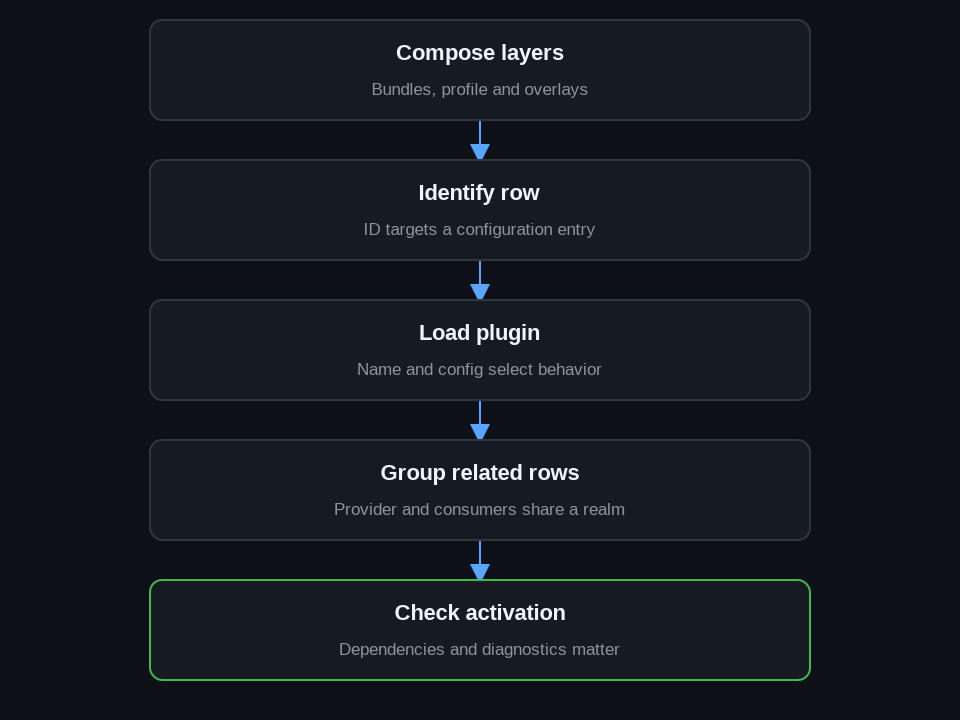
The architecture reference describes the application as a composition of plugins. Model adapters, tools, session logging and the agent loop are examples of capabilities supplied by plugins. Profiles combine ordered bundle patches, a profile patch, a home patch and command-line overlays into an entry list. A row in that list describes a component the loader should mount and, when applicable, its configuration.
The plugin configuration tutorial gives an inserted row with id, name, and config. In that example the ID is hello, the name points to the plugin module, and configuration supplies fields such as greeting and maxRetries. The plugin exports a same-named Config type and schema; Cordis validates the supplied values and fills schema defaults when loading. An invalid configuration fails the load.
DeepSeek Harness: how are ID, name and config different?
| Part | Purpose | Common misunderstanding |
|---|---|---|
id | Identifies a row for patch targeting | It is not necessarily a package name |
name | Identifies the plugin module to load | A module name alone does not describe all its settings |
config | Supplies values to that plugin | A later patch does not deep-merge its individual keys |
| Group | Contains related entries and may provide an isolated realm | Grouping is not itself a security guarantee |
| Bundle | Distributes patch layers and associated code | A bundle is not itself a configuration row |
The architecture reference says a patch can target a row by ID and replace its whole config, or insert new rows. If an earlier config has two values and a later patch supplies only one, do not expect the missing value to be inherited from the earlier row. A schema default may fill an omitted value, but that is the plugin's schema behavior, not a deep merge between layers. Inspect the actual plugin schema before deciding what to retain.
The tutorial's hello is a specific example ID, not a reserved name. The same module may be used in different rows for different purposes, but whether multiple instances are valid depends on the plugin and the services it registers. In particular, do not infer that arbitrary duplicate service providers can coexist in the same context merely because their row IDs differ.
DeepSeek Harness: what does a group do?
The app-boot reference identifies cordis:group as a native Loader builtin. It says a group row gives a provider and its consumers one isolate realm together. This matters when a composition needs a separate service instance and the consumers that should see it. The group provides structure for those entries; each child still has its own plugin and dependency contract.
Do not confuse a native group with a bundle, profile, or agent preset. A bundle distributes configuration; a profile selects a layered composition. The architecture reference describes a preset patch as applying operations inside the declaration's config.plugins. A group can appear inside a configuration tree, but its precise contents and isolation behavior must be read from the actual row and the relevant loader documentation. The sources do not support treating every arbitrary nested config object as a native group.
The app-boot reference also notes that ordinary Loader groups keep successful siblings when another entry fails. That is different from a consumer that explicitly owns an all-or-nothing subtree. A visible group does not prove every child activated. Inspect each relevant failure or pending dependency rather than assuming group membership makes startup atomic.
DeepSeek Harness: how do I inspect a specific entry?
- Identify the profile and all overlays used by the invocation. A row can be inserted by an earlier bundle and changed by a later profile, home or command-line patch.
- Locate the target row's
id,nameand completeconfig. If it is nested, note its containing group or preset and the service realm relevant to it. - Compare the final configuration with the plugin's own schema. Include every value that must be retained in a replacement, while distinguishing schema defaults from values inherited from earlier layers.
- Inspect required services and startup diagnostics. A correct row can remain pending when its required service is missing; a module import or schema error is a different failure.
- Apply the change in the appropriate layer and test the affected behavior. Check whether that composition supports live reload or requires a restart before judging the result.
The architecture documents dsh --profile web --dump-config as a way to inspect the assembled tree. The app-boot reference says this preview includes unevaluated !!js expressions and layer annotations. It reports configured composition, not proof of successful runtime activation.
DeepSeek Harness: why might a row not be active?
A row may be disabled, its module may fail to resolve, its schema may reject configuration, or it may be waiting for a required service. The Cordis primer explains that declared inject dependencies must be ready before a plugin starts. An ID that appears in a dump establishes neither that dependency readiness nor that the plugin successfully registered the desired behavior.
Expression evaluation adds another distinction. The primer says Loader interpolates a row's config after declared injections activate, against that plugin context, and evaluates disabled at mount decisions against the loader context. Other entry metadata remains literal. A dump showing an expression is useful evidence of configured input, but cannot alone reveal its runtime value. Compare the source layer, diagnostic and actual behavior.
When a patch appears ineffective, check the target ID, the layer that supplied it and warnings about unmatched rows. If the row is inside a preset, use the documented preset patch mechanism rather than assuming a root-level replacement reaches it. An incorrect scope can leave the original row unchanged even when the patch file itself parses successfully.
DeepSeek Harness: what are the limits and safety boundaries?
A group or isolate realm organizes services; the cited material does not describe it as a security sandbox for untrusted code. Plugins run code, and configuration or schema inspection can execute plugin code in some workflows. The app-boot reference specifically warns that schema collection imports modules and is not a sandbox. Only inspect or load code in an environment appropriate to its trust level.
Configuration and errors can contain secrets. Review exports and logs before sharing them. Keep a recoverable copy of the relevant user patch and verify the installed version's schema before changing a whole row. A syntactically valid or successfully loaded entry does not establish that its configuration is suitable for a particular deployment.
DeepSeek Harness: what do the terms mean?
- Entry or row: a configuration item describing a plugin and its settings.
- ID: the row identifier used to target changes.
- Config: plugin-specific input validated by its schema where supplied.
- Group: a native Loader structure for related entries and a shared isolated realm.
- Preset: a declared composition whose plugin entries can receive preset-scoped patches.
- Bundle: a distribution of code and configuration patch layers.
Frequently asked questions
What does a row ID do?
It identifies an entry that a patch can target.
Does a patch deep-merge config?
No. A patch replaces the targeted row’s whole config value.
Is a group a security sandbox?
The cited references describe service composition, not a security sandbox.
Sources
Every claim in this article was checked against the sources below. Community discussions are user reports, not official behavior.
This is an independent community article, not official DeepSeek documentation. Listing a plugin in the registry is not a security review.