Does DeepSeek Harness Support Multi-Folder Workspaces?
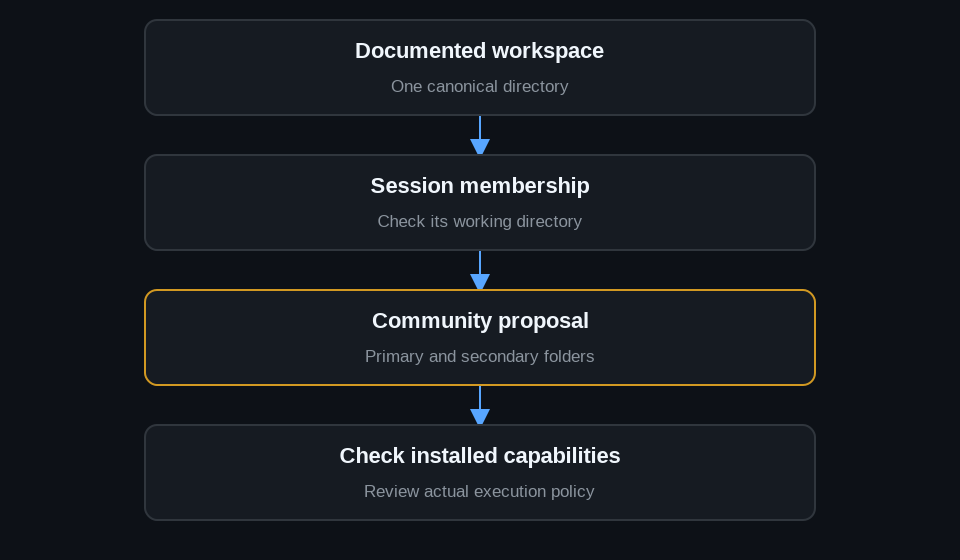
The documented DeepSeek Harness workspace is a persistent record for one canonical directory. A community proposal describes a workspace with multiple folders and a primary root, but its proposed design is not evidence that your installed version implements it.
DeepSeek Harness: what does a workspace contain today?
The workspace reference describes a stable id over a canonical directory path, a display title and an ordered account of sessions. The registry is an optional host-side capability, not a model tool or a prompt contribution. It checks session membership against the session header's working directory. A workspace is therefore an organizational record associated with a directory, not a collection of arbitrary folders merely because the task spans repositories.
The registry canonicalizes paths using the filesystem. Registering the same canonical path again returns the existing record; different display titles or symlink spellings do not create independent directory identities. The creator of a session sets its working directory; the registry checks whether the session belongs to the workspace. These separate responsibilities matter when investigating a session that appears under an unexpected directory.
DeepSeek Harness: what does the community proposal ask for?
Discussion #5505 is a feature idea. Its author proposes replacing a single path with an ordered folder list, designating a primary folder, migrating existing records and allowing multiple writable roots in the sandbox. Under the proposal, a new session's working directory and automatic discovery would remain anchored at the primary folder; secondary folders would participate in the proposed writable scope. The proposal also sketches UI changes and migration requirements.
These are the author's proposed semantics, not documented current behavior. A reply in the discussion reported lack of support in a particular earlier alpha version; later comments request the feature. Neither the idea nor that historical comment establishes the status of every subsequent release. Check your installed version's documentation and release information before relying on any multi-folder feature.
| Question | Documented workspace reference | Community proposal |
|---|---|---|
| Directory identity | One canonical path per record | Ordered folder list with a primary |
| Session association | Check recorded working directory against workspace path | Proposed membership across the folder set |
| Discovery | Not a multi-folder discovery contract | Primary remains the proposed anchor |
| Write access | Workspace registration is bookkeeping | Additional writable roots are requested |
The distinction between organization and enforcement is central to the proposal. A UI grouping several directories would not alone establish what a sandbox permits. The discussion requests changes to the execution policy and multiple backend implementations, as well as the workspace model. Those details explain why a sidebar feature should not be interpreted as proof of multi-root write enforcement.
DeepSeek Harness: how can I organize work across repositories?
- Identify the directories involved and what the task needs to read or change. Check which directory is selected for the session and confirm its recorded working directory.
- Review the installed deployment's permission and sandbox documentation. A workspace record is not a grant of access to additional directories; determine the actual policy before attempting cross-directory changes.
- Where appropriate for the project, choose a directory that legitimately contains the relevant work, or use separate workspace records and sessions. Each choice changes organization and may change the scope of available access; assess that scope before using it.
- If using separate sessions, carry necessary context deliberately and verify changes in each repository. The reference does not promise that independent workspace records become one multi-folder project or share a single grouped history.
- If a needed operation cannot be performed under the available policy, consult the operator and the applicable permissions workflow. Review each requested action instead of assuming that a broad access mode is required or suitable.
A common parent directory may include unrelated files. Selecting it can change the context and policy root used by a deployment, so inspect its contents and the actual permission settings first. It is an organizational choice, not an automatic substitute for the proposed multiple-root feature. Creating symlinks also does not turn multiple canonical paths into a documented folder list; check path resolution and tool behavior rather than assuming it changes the policy.
DeepSeek Harness: what happens to sessions and history?
The workspace reference says a session is attached only after checking its recorded working directory against the workspace path. The registry bootstraps its account from persisted session headers on first successful start; legacy sessions without a working directory remain ungrouped. Later sessions join through explicit attachment. That model helps explain why a related conversation can exist without appearing in the workspace's ordered account.
Removing a workspace registration removes its account and ordering entry; the reference says it does not delete the directory, user files, live sessions or stored logs. Sessions become ungrouped. Conversely, a missing directory can leave a record whose status indicates the path is unavailable. Unregistering is not a backup, and a familiar title is not evidence that the original path still exists.
The proposed multi-folder migration and session-membership rules are different from these current documented rules. If a future version adopts them, check the actual release contract rather than assuming every detail of the discussion was implemented unchanged. For the current single-directory selection flow, see selecting a workspace.
DeepSeek Harness: what are the limits and safety boundaries?
The workspace registry is host-side bookkeeping. Its reference does not say registration confines an agent's access, and the proposal does not establish a released multi-root security boundary. Inspect actual sandbox and approval settings for the installed host. Neither selecting a parent directory nor creating separate records makes a task safe.
Paths and session history may contain private project information. Review them before sharing diagnostics. The discussion includes proposed fields and interface changes; do not paste them into configuration as if they were available keys. The sources do not provide a universal command to add a secondary directory to a workspace.
DeepSeek Harness: what do the terms mean?
- Workspace: a persistent record for one canonical directory and its ordered session account.
- Canonical path: the filesystem-resolved path used for registry identity and membership.
- Working directory: the directory recorded for a session and checked during attachment.
- Primary folder: the proposed anchor in the community's multi-folder design.
- Writable root: an execution-policy boundary, distinct from a workspace's organizational record.
Frequently asked questions
Does the reference describe several folders per workspace?
It describes a persistent record for one canonical directory path.
Is discussion #5505 an implemented specification?
It is a community feature proposal; check the installed release for actual capabilities.
Does a workspace record grant write access?
The registry is host-side bookkeeping; inspect the applicable execution policy separately.
Sources
Every claim in this article was checked against the sources below. Community discussions are user reports, not official behavior.
This is an independent community article, not official DeepSeek documentation. Listing a plugin in the registry is not a security review.