DeepSeek Harness: Find Persisted Session Event Types
Use the DeepSeek Harness persistence event catalog to look up an event's declared envelope and resolved data type, then use the persistence reference to understand what a stored log can actually show.
DeepSeek Harness: Where is the event vocabulary?
The generated Session Persistence Event Catalog enumerates repository-declared durable session events, their source declarations, and resolved types. It also documents the logical and physical headers and the common event envelope. Experimental plugin records have a separate catalog; event types supplied by external plugins are outside the repository catalog and require their own declarations.
The companion persistence reference explains the storage contract: persistence carries the existing SessionEvent log, not a separate set of persisted event types. The catalog answers what a record can contain; the persistence page explains reads, writes, flushing, and recovery.
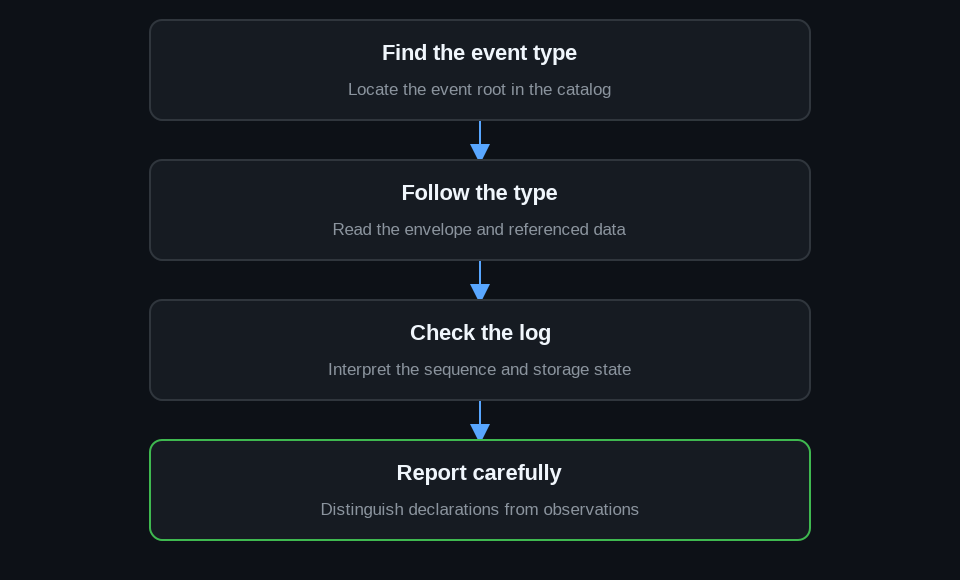
DeepSeek Harness: How do I find a specific type?
- Start with the observed event's exact
type, and search the catalog's root table for the correspondingevent:entry. For example, look forevent:tool/callorevent:turn/end; theevent:prefix identifies a catalog root, while the event's own type is the part after it. - Open its resolved-type link. Read the event's declaration, source location and referenced definitions together, including required and optional fields. Follow nested references instead of inferring a payload from the event name.
- Read the common envelope:
type,seq,time, anddata, with optionalignorableand conditionalsurfaceOpandsourceEventSeqs. Determine whether the detail you need belongs to the envelope or the event-specific data. - Compare the catalog with the version and plugins that produced the record. Consult the separate experimental catalog or an external plugin's declaration where relevant. Do not assume an event missing from the repository table cannot exist in another composition.
- Use the persistence reference to interpret the read and durability state. If investigating a failure, retain the event sequence and enough surrounding context to understand it, while removing sensitive content before sharing.
The table's resolved-type link is more useful than just a name. A type can refer to other structures; the resolved definition reveals the transitive shape. The catalog is generated from declarations, so consult the matching source when the deployed version differs from the current documentation.
DeepSeek Harness: What does the catalog distinguish?
| Catalog item | What it describes | What it does not establish |
|---|---|---|
| Event root | A declared durable event variant | That every session contains it |
| Envelope | Shared sequencing and event metadata | The complete event-specific payload |
| Header | Session or physical-log metadata | An ordinary event in the log |
| Surface event | An event eligible to produce model history | That every stored event is model-visible |
| Fingerprint | Normalized reachable type structure | Runtime behavior or opaque payload contents |
The envelope distinguishes surface events, which produce model history, from log-only events. Conditional fields should be interpreted with their declared types; their presence is not a license to assume that all stored records become messages. Similarly, the logical session header and the JSONL physical header are catalog roots, but they have different roles from an appendable event.
The table also links a SHA-256 fingerprint for each root. The machine inventory fingerprints reachable normalized types, including referenced types. Field names, types, optionality, and tuple order affect a fingerprint; comments and harmless reordering do not. This helps review type changes, but a matching fingerprint does not prove behavior is unchanged. Catalog wording and source locations can change even if the digest stays the same.
DeepSeek Harness: How do storage and recovery affect interpretation?
A SessionHandle is the per-session access point. read returns a slice of a valid contiguous logical log, not a torn physical tail. An append is accepted and ordered when it resolves, but a resolved flush is the durability barrier for acknowledged appends. Thus an event type's presence in the catalog does not prove that a particular event was flushed or survived a crash.
An interrupted turn can have a durable turn/start and no turn/end. The persistence layer preserves the valid log rather than truncating that turn. On resume, the agent loop can append synthetic closers under write ownership, including an interrupted turn ending; a read-only observer balances a cold log in memory without writing those closers back. These distinctions matter when comparing a raw record with a prepared view. A missing ending at an interrupted tail is evidence to investigate, not automatically proof that the schema is wrong.
A read handle cannot append; attempts to mutate it raise SessionReadOnlyError. A second write owner is rejected while the first is active. A handle's close() is the teardown and is idempotent. These are storage operations, not new event types, so use the persistence API contract when building a reader instead of editing a backend file directly.
When comparing two investigations, record both the software version and how the view was obtained. A declaration describes an allowed structure, while the session sequence establishes which records were actually observed. Similar event names alone do not prove a particular pairing; inspect the relevant data definitions and the subsystem that emits them. A prepared read-only view and a later resumed log may differ because recovery has different responsibilities in each path. Preserve that distinction in any report so readers can reproduce the observation.
DeepSeek Harness: What are the limits and safety boundaries?
The catalog covers declarations in its repository, not every third-party plugin, every historical deployment, or the meaning of opaque payloads. A structural type or digest cannot by itself establish whether an event occurred, what the user saw, or whether a side effect succeeded. Consult the owning subsystem and the stored sequence for those questions. Avoid hard-coding a particular digest or catalog layout as a permanent runtime API.
Session records can contain user messages, tool arguments, and results. Treat an investigation export as potentially sensitive and inspect it before sharing. Read-only access limits mutation through that handle; it does not anonymize the contents. Do not alter a live session log merely to make a trace look complete.
DeepSeek Harness: What do these terms mean?
- Event envelope: common fields around an event's type-specific data.
- Surface event: an event eligible to produce model history; log-only records do not do so.
- Resolved type: the declared event shape with referenced structures exposed.
- Fingerprint: a digest of normalized reachable type structure used for change review.
- Flush: the persistence barrier for acknowledged appends.
Frequently asked questions
Does the catalog include external plugins?
No. External plugin event types require their own declarations.
Does a listed event appear in every session?
No. The catalog describes declared types, not occurrences in a particular log.
Does append guarantee crash durability?
A resolved flush is the durability barrier for acknowledged appends.
Sources
Every claim in this article was checked against the sources below. Community discussions are user reports, not official behavior.
This is an independent community article, not official DeepSeek documentation. Listing a plugin in the registry is not a security review.