DeepSeek Harness: Session Telemetry and Token Counts
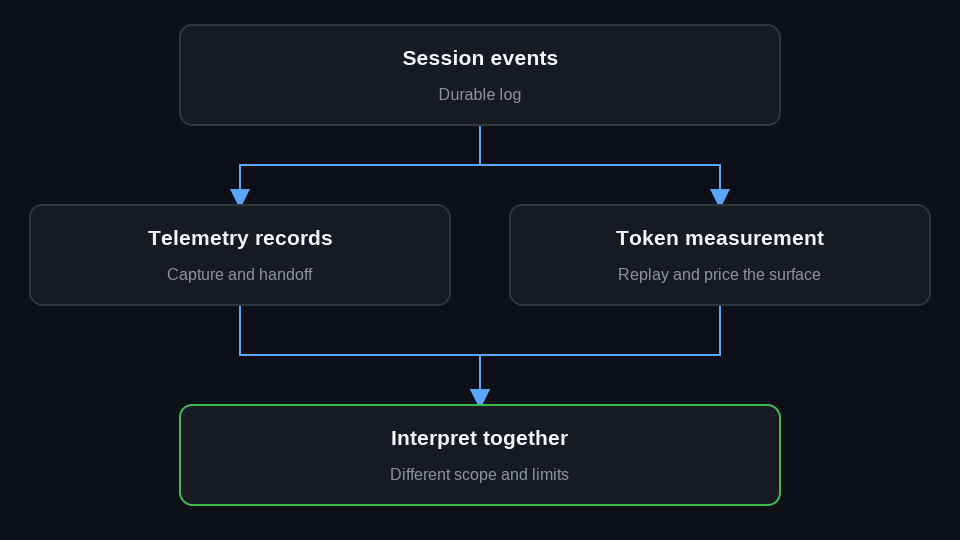
DeepSeek Harness session telemetry exports selected records from a session, while the token meter measures the current request surface and pressure. They answer different questions and neither is a complete billing ledger.
DeepSeek Harness: what does each subsystem measure?
The session telemetry reference describes capture, redaction and handoff of canonical session events to a backend. A ledger record mirrors a durable session event; an operational record represents an agent-error or shutdown signal that has no log-event identity. The reporting data does not enter model requests. Capture configuration and backend authorization determine what is handed off.
The token meter instead replays a session to produce a detached measurement of request pressure and positional surface pricing at a particular durable log revision. It can use a qualifying provider-usage anchor or estimate the complete envelope and surface. The number of exported telemetry records is not the current token count, and the measured current surface is not a sum of every request ever made.
| Question | Session telemetry | Token meter |
|---|---|---|
| Main unit | Ledger or operational record | Immutable measurement snapshot |
| Time boundary | Captured events or explicit prefix | Durable log revision and effective request envelope |
| Primary use | Reporting and operational evidence | Current request pressure and surface pricing |
| Completeness | Best-effort handoff; may lose or duplicate | Estimate or qualifying provider anchor, not invoice |
DeepSeek Harness: what is in a telemetry record?
A ledger record contains a canonical envelope without event data, a separately copied body, severity, time and minimal identity attributes. For ledger records, identity includes session.id, session.format_version, event.type and event.seq; some context attributes are optional. Operational records use a separate channel and deliberately omit event-sequence identity. A receiver can deduplicate ledger records using the session ID, format version and sequence; operational signals must tolerate duplicates instead of being treated as ledger rows.
Canonical events pass through as whole ordered ledger records, including assistant messages and plugin-defined event types. Process-local streaming frames do not enter this durable feed. Severity defaults to info for captured events, with documented error outcomes mapped to error; policies and backends can also use warn. Severity is an operational classification, not a token total.
Handoff is best effort. The cursor marks records handed to a backend, not confirmed delivery. A crash or reload window can lose records; a new-object replay or SDK retry can duplicate them. A fork starts with its child-owned suffix unless history is included, and a restored session normally begins after its stored prefix. Record absence therefore does not by itself prove that the corresponding work never happened.
DeepSeek Harness: what does a token snapshot mean?
logRevision records the number of durable events consumed. baseline identifies the provider-usage or estimated anchor; surfaceDeltaTokens is a signed repricing of the current surface relative to that anchor. totalTokens is non-negative request-and-response pressure, whereas surfaceTokens is the current surface-only total and equals the sum of node prices. Nodes are in surface order, which need not match numeric event sequence order after replacement.
A usage baseline is reused only when the latest successful provider call has the same canonical request envelope and its total is no lower than the full route-priced anchor. Otherwise the meter estimates the complete envelope and surface. A later successful request replaces the earlier anchor. The routed provider and model select declared image pricing where available; otherwise the fixed heuristic is used. Consequently the same visible surface may have different prices under different routes.
A positive or negative surface delta describes growth or shrinkage relative to an anchor, not a new invoice line. Nor should surfaceTokens simply be added to totalTokens: they describe related measurements with different scope. Record the revision and route with a value so that two observations can be meaningfully compared.
DeepSeek Harness: how do you correlate the two?
- Identify the session and the question. For an incident, decide whether you need event evidence, present request pressure, or both.
- Check the deployment's telemetry sharing and capture settings.
full,feedback-onlyanddisableddescribe the deployment's sharing mode, not a delivery receipt.includeHistorypermits a prefix but does not authorize capture on its own. - Obtain the applicable records from the deployment's configured backend and retain their session and sequence identity. Deduplicate ledger records before aggregating them; treat operational records as signals.
- Obtain a token measurement for the same session and record its
logRevision, route, baseline and fields. Compare snapshots only with their boundaries and envelope in mind. - Explain gaps and differences. A best-effort telemetry export and a detached current-surface measurement do not promise identical coverage or timing.
For an inspection procedure focused on interpreting the measurement fields, see model usage telemetry. The references do not establish a universal dashboard or command for every deployment, so use the actual backend and interface supplied by your installation.
DeepSeek Harness: what are the limits and safety boundaries?
The telemetry seam ships no redaction rules of its own. Without a mounted listener, captured records reach the backend as captured. Redaction transforms an exported copy, not the canonical session log. Review the actual policies, destination and access arrangements before sharing records; a telemetry plugin's presence is not a privacy guarantee.
The feedback backend uses on-demand capture and requires new explicit feedback for the released session prefix. Its queue and byte ceiling are backend-specific. A sharing disclosure is neither admission for a particular session nor confirmation of delivery. Likewise, estimates and request pressure should not be represented as exact billed usage or cost without an independent billing source.
When comparing operational reports, keep the capture mode and history policy beside the numbers. A receiver may see only a portion of the canonical log, and the meter measures the surface at its own revision. If an event appears twice, apply the documented ledger identity before aggregating it. If a record is missing, distinguish an unauthorized prefix from a handoff or delivery gap before drawing a conclusion. Preserve these qualifications when passing the analysis to someone who did not inspect the original session.
DeepSeek Harness: which terms matter?
- Ledger record: telemetry copy corresponding to one canonical session event.
- Operational record: an unsequenced operational signal rather than a session-log row.
- Handoff cursor: position through which records were handed to a backend, not proof of delivery.
- Baseline: provider usage or an estimate anchoring a token measurement.
- Surface: current ordered model-visible nodes priced by the token meter.
Frequently asked questions
Is telemetry a token counter?
No. It captures session records; the token meter separately measures current request pressure and surface.
Does a handoff cursor prove delivery?
No. It records handoff to the backend, and delivery is best effort.
Are token measurements an invoice?
No. They describe request pressure and surface pricing, not a complete billing ledger.
Sources
Every claim in this article was checked against the sources below. Community discussions are user reports, not official behavior.
This is an independent community article, not official DeepSeek documentation. Listing a plugin in the registry is not a security review.