DeepSeek Harness: How Session Titles Are Generated
DeepSeek Harness titles start with a deterministic fallback from an eligible human message; an optional provider can revise them asynchronously, while a user rename pins the title until an explicit refresh.
DeepSeek Harness: what produces the first title?
The session title reference describes durable title revisions, and the service README describes when they are produced. The service must be mounted in the deployment. It takes leading words from the first eligible human message and constructs a fallback under configured word and UTF-8 byte limits. Only text blocks of human user/message events qualify. Empty or non-text input waits for later eligible input.
That distinction matters when the first visible activity is an injected message, a tool result, or an image-only prompt. These do not establish that the service has eligible human text. A fallback is useful even when no optional generator is registered; it does not require a model call. Its arrival may be asynchronous, so it is not a guarantee that every list row has a title immediately at session creation.
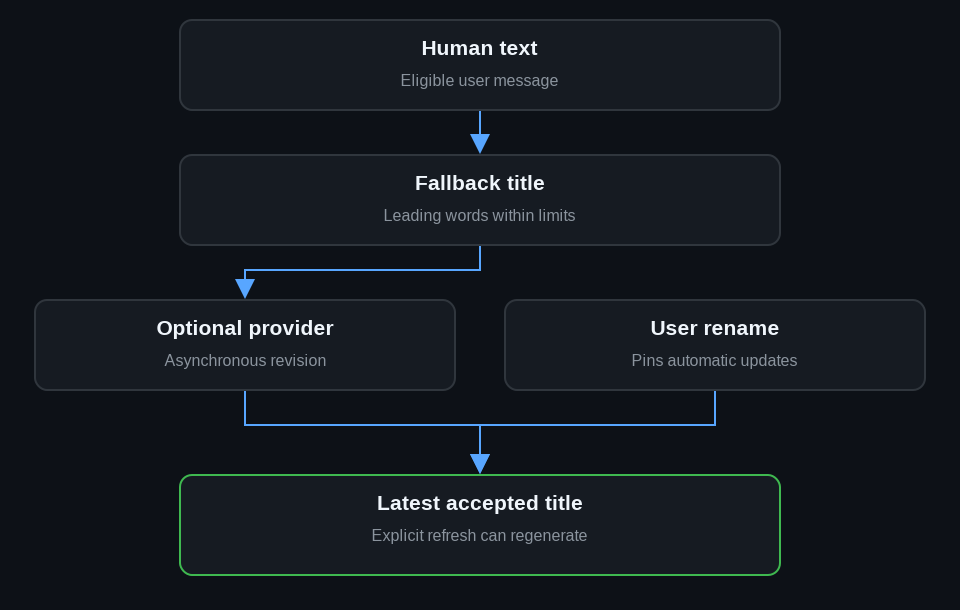
| Source | Input | Consequence |
|---|---|---|
| Fallback | First eligible human text | Leading words within configured limits |
| Provider | Snapshot of eligible human messages | Optional asynchronous revision |
| User | Explicit rename | Pins the latest title against automatic scheduling |
| Explicit refresh | Current eligible messages and registered provider | Deliberate regeneration path |
DeepSeek Harness: when can a generated title change?
A deployment may register at most one title provider. Its automatic mode is first-prompt or all-prompts, so the answer depends on the provider chosen. The service snapshots eligible human messages through a revision and supplies the latest accepted title as currentTitle; the provider decides whether to use it. Its result identifies the source message sequence numbers, and the service checks and normalizes the proposed title before acceptance.
The service README explains that an automatic provider starts only after a marked loop-built request's route matches the logged request/header. Newer work supersedes and aborts older work, and stale completions cannot append. Automatic generation does not delay the main agent response. A fallback and a later provider revision can therefore appear at different times. An automatic failure produces a warning and retains the latest accepted title.
The first-prompt provider has eligibility boundaries: seeded and subagent-origin sessions are excluded, and an independent fork does not become eligible merely because its source relationship is absent. Do not generalize its behavior to every provider. Forks inherit title events in their seed, according to the service README.
DeepSeek Harness: what happens after a rename or refresh?
An explicit rename(session, title) records a user-sourced title, supersedes in-flight automatic work, and stops scheduling automatic revisions for later human prompts. That pin protects the user's choice from an ordinary subsequent message. The documented refresh(session) is the deliberate unpin and regeneration path: it ensures a fallback when needed and explicitly invokes the registered provider over current eligible messages. Refresh is a service API; the sources do not promise a refresh control in every client.
Refresh can fail or be cancelled. Unlike an automatic failure, an explicit refresh rejects on provider error or caller cancellation. An already accepted fallback is not rolled back by cancellation. The model-backed execution module also notes that a refresh before a logged route exists needs an explicit provider/model override pair. These details explain why a manually named session can remain unchanged after another message, and why a failed refresh should not be described as a successful rename.
DeepSeek Harness: how can you investigate an unexpected title?
- Confirm that the title service is mounted and the session has an eligible human text message. If the input is empty or non-text, provide eligible text before expecting a fallback.
- Identify the latest title source: fallback, provider, or user.
ctx.sessionTitle.get()exposes the folded snapshot for integrations; the client projection itself contains just the title ornull. - If expecting generation, check that a provider is registered, its automatic mode, the session's eligibility, and whether the marked request has a matching logged route. A visible fallback alone does not prove the provider ran.
- If a user rename is latest, understand that later prompts do not automatically overwrite it. Use an explicit refresh only when regeneration is actually desired and the integration offers it.
- Inspect warnings and the relevant log records after a failure. Compare the accepted
session/titlerevision with asession/title-llm-requestif a model-backed provider was dispatched. Redact message content and route details before sharing.
The title event records normalized text, its source, and messageSeqs. An explicit rename has an empty sequence list. A provider source can include provider and model identity. The snapshot also carries the event sequence and update timestamp; these are useful for distinguishing a prior accepted revision from an attempted but failed update.
DeepSeek Harness: where are titles stored, and what are the limits?
Accepted revisions are log-only session/title events. The latest event wins when folded; the client-facing title projection exposes only the string or null. The session reference supplies the broader event and session context. A title event survives replay, resume and paging according to the service README, but does not enter the main model conversation, system prompt, or tool schemas.
A model-backed generator is a separate auxiliary request. Its input and exact route are recorded in session/title-llm-request before dispatch, even if generation subsequently fails. This record may contain human text, so a title-generation log deserves the same care as other session data. It also consumes model tokens separately; the absence of title text from the main request does not make that auxiliary call free.
The service cleans control characters, normalizes whitespace, and truncates on UTF-8 boundaries. Its required fallbackMaxWords, fallbackMaxBytes, and maxTitleBytes are deployment choices, not universal defaults. It does not provide title deletion, search, or list indexing. A generated label is a convenience for finding a conversation, not a complete summary or a guarantee that sensitive words are absent. Check the actual deployment and review titles before exposing a session list to others.
DeepSeek Harness: what do the terms mean?
- Fallback: deterministic leading words from the first eligible human text message.
- Provider: the optional implementation that proposes asynchronous revisions.
- Pin: the effect of a latest user rename on automatic scheduling.
- Projection: a client-readable fold whose title view is a string or
null. - Refresh: an explicit service operation that can unpin and regenerate a title.
Frequently asked questions
Does a title require a model?
No. The fallback derives from eligible human text without a model call.
Does a rename stop automatic changes?
Yes. A user rename pins the title until an explicit refresh.
Does the title enter the main model prompt?
No. Title events are log-only, although model-backed generation uses a separate request.
Sources
Every claim in this article was checked against the sources below. Community discussions are user reports, not official behavior.
This is an independent community article, not official DeepSeek documentation. Listing a plugin in the registry is not a security review.