DeepSeek Harness: stdio vs. Streamable HTTP MCP
DeepSeek Harness can launch an MCP server as a stdio child or connect to an already running Streamable HTTP server. The transport changes process ownership, configuration and network diagnosis; it does not determine whether the server or its tools are trustworthy.
DeepSeek Harness: what changes between transports?
The memory MCP guide describes the generic client: DSH parses a selected Cordis overlay, starts the configured stdio command or connects to the configured Streamable HTTP URL, discovers tools and exposes them as mcp__<serverName>__<tool>. Both paths can make tools available to an agent, but their operational prerequisites differ.
For stdio, the client starts and stops the child with the DSH plugin lifecycle. For HTTP, the upstream service must already be running; DSH does not supervise that separate service. DSH also does not download a server, initialize its database, create its cloud account or choose its model or embedding provider. A working transport alone does not perform those provider-specific setup tasks.
| Question | stdio | Streamable HTTP |
|---|---|---|
| Endpoint | A configured child command | A configured URL of a running service |
| Lifecycle | Client starts and stops the child with the plugin | Upstream service runs separately |
| Generic configuration | transport, command, args, env, cwd | transport, url, headers |
| First diagnosis | Executable, arguments, environment and child startup | Service availability, endpoint, authentication and network path |
| Proxy consideration | Child inherits remaining environment; its own runtime matters | DSH outbound HTTP MCP follows its documented proxy rules |
The guide's three memory examples are default-off interoperability references, not endorsements. They all use stdio; the generic HTTP fields show how to bring a different remote server, not a promise that any particular provider offers that transport.
DeepSeek Harness: how is a stdio connection configured?
The guide supplies this generic row for a different MCP server:
- insert:
    - id: memory-my-server
      name: '@deepseek-ai/dsh-mcp-client'
      config:
        serverName: my-memory
        transport: stdio
        command: my-memory-mcp
        args: []
        env: {}
        cwd: !!js process.cwd()
The command is an illustrative server executable, not something DSH installs for you. Use a unique id and serverName, supply the actual provider's supported command and arguments, and meet its own prerequisites. The guide's pinned memory-server examples have their own installation and storage instructions; do not assume one provider's paths or settings apply to another.
Before starting the child, the bridge deliberately removes ambient variables whose names usually indicate credentials and all DSH_* variables. Other ambient variables remain inherited. If an optional upstream feature needs another secret, the guide directs the operator to the row's config.env rather than putting the secret directly in YAML. Check the server's requirements and your secret-management practice; filtering some variables does not mean that the child has no access to sensitive information.
Initial discovery is asynchronous. Wait for the provider's mcp__... tools before concluding the connection has failed. The guide describes a crashed child reconnecting with backoff and tool resynchronization. Calls can fail during the outage while tools remain listed; once the reconnect budget is exhausted, tools are unregistered and reconnection stops until reload or restart. A listed name is therefore not a live health check.
DeepSeek Harness: what is different for HTTP and proxies?
For a remote server, the guide specifies transport: streamable-http, url and headers in place of the stdio fields. Obtain the endpoint and authentication requirements from that server's own documentation. The guide does not provide a universal URL, header or login procedure, so copying a made-up value would be misleading. The service must be operating before DSH can connect.
The network proxy guide says DSH reads standard proxy environment variables at startup for outbound HTTP MCP traffic. HTTP_PROXY and HTTPS_PROXY can select a proxy, and NO_PROXY identifies hosts that should be direct. DSH always bypasses loopback. The guide says CIDR entries do not work in NO_PROXY, while hostnames and domain suffixes do. This matters when a remote endpoint is reachable from a browser but the DSH process has different proxy settings.
Proxy behavior for a stdio child is a separate question. The network guide says spawned commands and MCP children inherit proxy variables, but a child Node program honors them only on Node 22.21 or later; other server runtimes have their own behavior. Check the server's outbound path rather than assuming it uses DSH's HTTP client. Proxy URLs can contain credentials that child commands can read; avoid exposing them in logs.
DeepSeek Harness: how should you choose and verify?
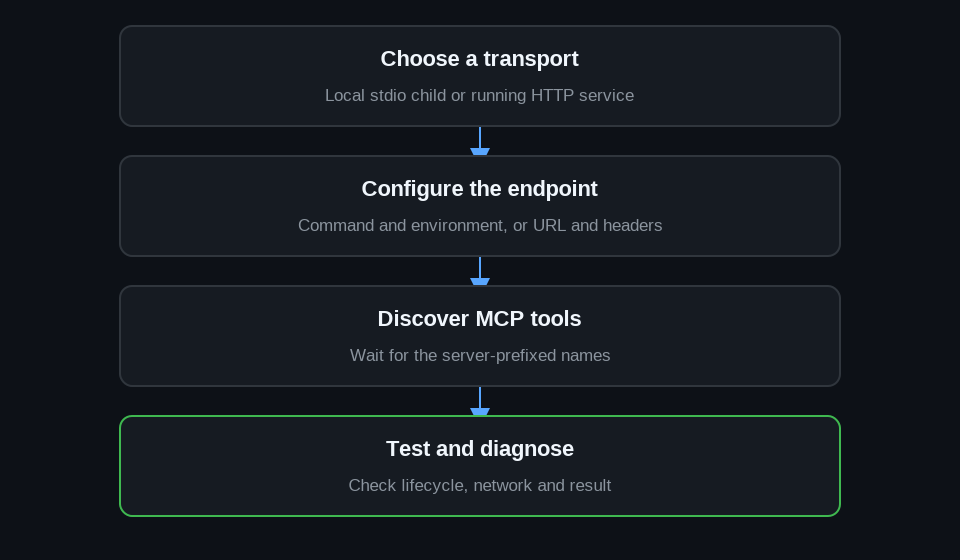
- Determine whether the provider supplies a local executable, an already running Streamable HTTP service, or both. Review the provider's installation, identity, authentication and storage requirements.
- For stdio, prepare the executable and configure its command, arguments and required environment. For HTTP, start or identify the service and obtain its URL and required headers from the provider.
- Add the chosen client row to an appropriate overlay, with unique identity. The guide's example overlays are opt-in; merely having a server installed does not add it to the shipped composition.
- Start or reload the relevant composition and wait for discovery. Check the names under
mcp__<serverName>__<tool>and inspect any connection errors. - Test one appropriate operation and inspect the returned result. For a memory integration, the guide proposes writing a unique test value, opening a fresh DSH session in the same Host, asking it to recall the value, then checking that a later response uses it.
That memory test exercises more than discovery: it checks a write, cross-session recall and use while the provider's storage scope remains unchanged. It is not a generic requirement that every MCP server offer memory tools. Select a non-sensitive, provider-appropriate test for other servers.
DeepSeek Harness: what are the limits and safety boundaries?
MCP tools execute capabilities provided by another server. Review the executable or service, its permissions, data retention and credentials before connecting it. A tool listing, successful connection or test result does not establish safety or continued service availability. An HTTP server's operator remains responsible for its service; DSH does not supervise it.
The stdio environment filter is selective and other variables remain inherited. HTTP headers and proxy settings may contain secrets. Avoid placing real secrets in shared examples and inspect logs before sharing. The proxy guide notes that SOCKS proxy URLs are unsupported and can result in direct connections for the affected scheme, so verify the actual network route when it matters.
DeepSeek Harness: what do the terms mean?
- stdio: a transport using a configured child process and its standard streams.
- Streamable HTTP: the documented remote connection type using a URL and headers.
- Overlay: a configuration patch that adds the MCP client row to a composition.
- Discovery: learning the upstream tools and exposing their DSH names.
NO_PROXY: a list of destinations the documented proxy configuration reaches directly.- Reconnect budget: the bounded retry allowance described for a crashed MCP child.
Frequently asked questions
Does DSH start an HTTP MCP service?
No. The separate upstream service must already be running.
Does a listed tool guarantee availability?
No. Calls can fail during a child outage even while its tools remain listed.
Are all environment variables removed from stdio children?
No. The bridge removes certain credential-like variables and DSH variables; others remain inherited.
Sources
Every claim in this article was checked against the sources below. Community discussions are user reports, not official behavior.
This is an independent community article, not official DeepSeek documentation. Listing a plugin in the registry is not a security review.