Why Does DeepSeek Harness Wait for Tool Approval?
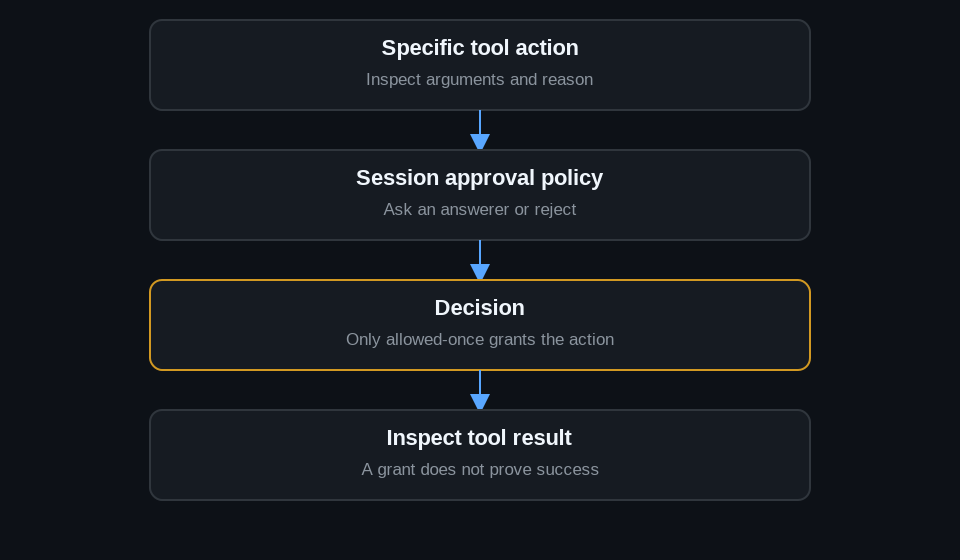
A DeepSeek Harness tool call can wait because the action requires a decision under the active approval policy. The approval request is tied to a particular action; only allowed-once grants that action, while rejection, cancellation and an unavailable answerer do not allow it to proceed.
DeepSeek Harness: what is the tool waiting for?
The approval reference describes a service that asks whether a specific action may proceed. A caller such as the tool registry or Bash tool requests a decision; an interactive client may supply an answerer. A pending prompt therefore often means the caller is waiting for that answerer to settle the request. It is not, by itself, evidence that the tool is broken or that the action has already executed.
The request identifies the agent and tool and can include a callId linking it to the already presented call. It can also include a reason. The request deliberately does not duplicate the tool arguments: the answerer attaches its prompt to the streamed call. Review the actual tool call and its arguments together with the stated reason before deciding. An approval identifier pairs audit records; it is not interchangeable with the tool-call or session identifier.
DeepSeek Harness: what happens under each policy?
| Policy or outcome | Documented behavior | Practical interpretation |
|---|---|---|
ask | Delegates to the composed answerer chain | A suitable answerer may present a decision; no answerer yields unavailable |
never | Returns rejected before dispatching answerers | No interactive prompt is sent for that approval request |
allowed-once | Grants the action asked about | Review the scope of that specific call |
rejected, cancelled, unavailable | Callers deny the action | No approval grant is obtained |
The effective policy comes from the last approval/policy event in the session log, falling back to the service configuration. The default described by the service is ask. A deployment's composition and session override matter; do not assume that a particular client has an answerer just because the policy is ask. An absent, non-owning, throwing or non-conforming answerer becomes unavailable, not permission to proceed.
A cancellation withdraws the request. The service discards a late response from an answerer that was still pending after cancellation. That behavior matters when diagnosing a prompt that disappeared: a late click should not be assumed to grant the withdrawn action.
DeepSeek Harness: how should I handle a waiting call?
- Locate the pending call in the owning session and inspect its tool, arguments and displayed reason. Determine the exact operation and its intended effect.
- Decide whether that specific action is authorized and appropriate for the task. If the reason or scope is unclear, seek clarification rather than guessing.
- Respond through the client that owns the request if an approval prompt is available. A one-time grant covers the action asked about; it is not a blanket grant for later calls.
- If no prompt appears, inspect the effective policy and whether an appropriate answerer is connected in the actual deployment. Under
never, an approval request is rejected without a prompt; underask, a missing answerer resolves as unavailable. - After a decision, inspect the tool result. A grant permits the asked-about action to proceed, but does not establish that execution succeeded or that the result is correct.
If a decision is unavailable, the reference describes a fail-closed result, not an instruction to change policy. Identify why the answerer is unavailable and whether the requested action remains appropriate before changing the environment. A tool can also fail for reasons outside approval; use its actual result and diagnostics rather than attributing every delay to this service.
DeepSeek Harness: is an approval the same as a user question?
The user interaction reference describes a separate question vocabulary used when a tool or permission plugin needs a human answer. Questions can have selectable labels, descriptions and details. A client may render a recognized presentation intent differently, but the option labels remain the answer protocol. A question can ask for information or a plan decision; its visible presence alone does not establish that an approval request was granted.
Timed questions have their own behavior. An unattended foreground timeout can return a pending result while the question remains answerable. Closing the client panel sends nothing, and a later reply can be admitted separately. Those documented semantics belong to timed user questions; do not transfer them to approval requests, whose closed outcomes and cancellation rules are described by the approval service. In particular, waiting for information and waiting for authorization can require different responses.
DeepSeek Harness: what does the audit record show?
An approval request must occur within an open session turn. The service appends approval/asked, obtains an outcome and appends the matching approval/decided. The audit pair is log-only and does not enter the model transcript as a pair of messages. The caller's derived tool result and the runtime-context snapshot are model-visible instead. A failure that prevents an audit append from committing can reject the request rather than returning an unlogged decision.
These distinctions help explain why an audit view and a model transcript need not have identical rows. The identifier connects the ask and decision, while callId connects the prompt to a tool call when present. Neither should be used as proof that the requested operation actually completed. Check the tool result for execution status and examine the affected output when appropriate.
DeepSeek Harness: what are the limits and safety boundaries?
Approval is a decision about the particular request, not a guarantee that the action or its consequences are safe. Review the target and arguments, especially for actions that alter files, run commands or reach external systems. The approval reference describes the service contract; which actions ask for approval depends on the composed tools and policy. It does not establish that every tool call must prompt.
A disconnected or missing answerer does not automatically grant access. Likewise, never is a policy for how approval requests resolve; it is not a complete description of all permissions or sandbox behavior. For the broader relationship see permission presets and sandbox.
DeepSeek Harness: what do the terms mean?
- Approval request: a decision about whether one specified action may proceed.
- Answerer: a composed handler that can own and decide a request.
- Approval policy: the session's
askorneverrule before answerer dispatch. - Call ID: an optional link to the tool call presented to the user.
- Audit pair: the log-only ask and decision events linked by an approval request ID.
Frequently asked questions
Does ask always display a prompt?
No. Without an applicable answerer the result is unavailable.
What does allowed-once cover?
Only the specific action requested.
Does approval guarantee success?
No. Inspect the tool result after the decision.
Sources
Every claim in this article was checked against the sources below. Community discussions are user reports, not official behavior.
This is an independent community article, not official DeepSeek documentation. Listing a plugin in the registry is not a security review.