DeepSeek Harness: Reconcile Web Search Usage
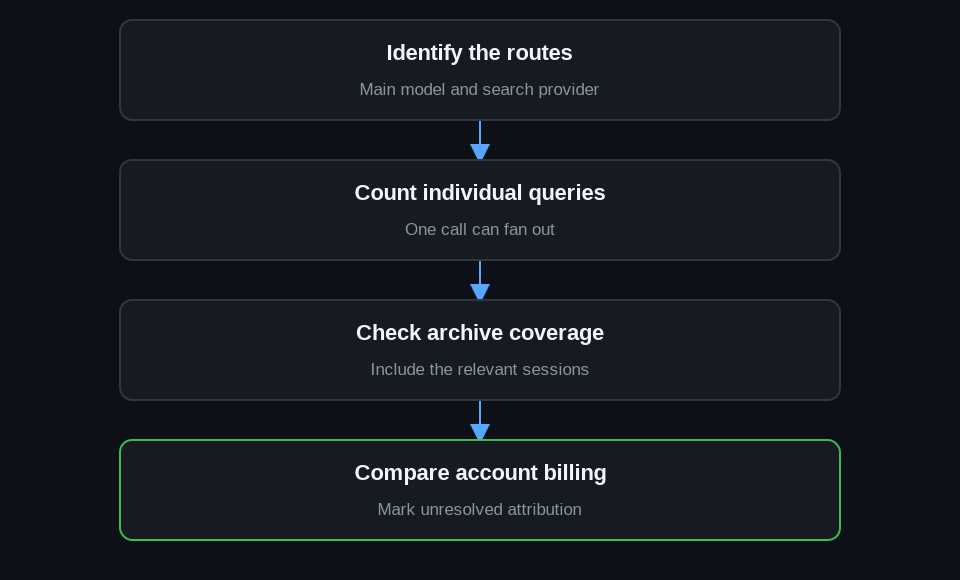
A DeepSeek Harness session's main model and its web-search provider can incur separate usage; reconcile the actual provider requests, session coverage and account billing before assigning search costs to a conversation.
DeepSeek Harness: why can the selected model be only part of the bill?
The web reference describes ctx.web as an optional capability with separate search and fetch operations. Providers register search or fetch capabilities, while dsh-tool-web exposes web_search and web_fetch to the model. Swapping a search provider does not change how the model asks for a query. Therefore the model shown for the conversation does not by itself identify the service processing search.
In discussion #10729, a user reports a desktop 0.2.1-rc.2 setup whose main model was MiniMax while search requests used a DeepSeek model. The author reports missing search usage in exported session data and proposes recording it. The report is evidence of that setup, not an official statement that all versions or providers lose usage.
DeepSeek Harness: why don't tool calls equal provider requests?
The tool consumer accepts a queries array, but each search request at the seam carries one query. The consumer fans an array into separate seam requests. One tool call with several queries can therefore produce several searches. The searchMaxResults consumer configuration defaults to 8; results beyond the bound are truncated by the seam and marked truncated. A result limit is not a token or cost limit.
| Item | What it measures | What it cannot establish alone |
|---|---|---|
web_search tool call | A model-facing invocation with a queries array | Number of provider requests if the array has several entries |
| Search request event | Evidence of a request in the relevant recorded path | Response usage or the final charge |
| Session export | Records included in that export | Whether other sessions or subagents were included |
| Provider account bill | Account-level metering for its billing period | An exact per-session allocation without a shared identifier |
The report counted 595 tool calls in two parent sessions and 1,833 search requests in their GUI exports. A later local archive review counted 2,717 across a wider set of sessions and dates, including 2,470 on the reported billing day. These numbers have different populations and should not be used as a generic ratio. The author compared the latter day with an account aggregate of 28,769,009 tokens and ¥68.30; that attribution and arithmetic are the user's investigation, not a transferable price or per-query rate.
DeepSeek Harness: how can I investigate a mismatch?
- Record the installed version, profile, time window and billing account. Identify the main model separately from the configured or selected search provider. Preserve the configuration and time-zone assumptions used for the comparison.
- Count tool invocations and individual queries separately. Inspect the
queriesarrays where available, and compare them with provider-side request evidence. Avoid treating the number of returned links as the number of requests. - Determine the coverage of each export. Include relevant parent and subagent sessions if your authorized archive permits it, and label any missing records. Align the request interval with the provider's billing window before comparing totals.
- In the reported DeepSeek search path, the user found
web/deepseek-search-llm-requestevents containing request information but no response usage. Check whether your version and provider record comparable evidence; absence in one export is not proof of zero usage. - Compare account-side input, cached input, output, pricing period and currency with the request evidence. Record unrelated activity on the same account. If there is no common request identifier or per-request usage, present a range or an unresolved difference instead of claiming an exact session cost.
The author initially counted the GUI export, then revised the count after inspecting a broader archive. That distinction illustrates why a partial export can appear consistent while omitting activity. A provider bill can include requests outside the selected session, and provider-side aggregation may not preserve a conversation identifier. Neither source alone resolves both issues.
DeepSeek Harness: what does the report say about provider choices?
The reporter attributes the observed route to an unset searchProvider and a single available search provider in that installation. The web reference documents the capability and its distinct provider implementations; it does not establish that every installation has the same registered providers. Inspect the actual composition and version rather than inferring a default from this single desktop report.
The discussion also describes a direct Search/Fetch API option that does not need an auxiliary model request, and reports that its setting was disabled in the author's setup. That is a reported alternative for that environment, not a promise of zero charges or equal results. Check the installed provider's documentation, availability, billing terms and operational requirements before changing it. Changing a provider can change the external service and the data sent to it, even though the model-facing tool name remains the same.
What should the reconciliation record contain?
Write down the start and end of the interval, its time zone, the account, the search route and which sessions were included. Keep separate columns for tool calls, individual queries, recorded requests and provider usage. Record any other activity charged to the account during that period. If the bill is aggregated by model and the session does not include response usage, an exact allocation remains unsupported. A small controlled comparison after a provider change can show how that deployment behaves, but one observation is not a promise of future per-search cost or equivalent results.
DeepSeek Harness: what are the limits and safety boundaries?
Do not publish raw search requests, session archives or provider credentials when seeking help: queries and request bodies may contain sensitive information. Share a sanitized count, the observation window, version, provider route and the scope of the evidence. Retain the difference between a missing usage field and a recorded zero.
The sources do not document a universal conversion from searches to tokens, a guaranteed per-session bill, or a current price. Search result volume, request structure, provider metering and other account activity can affect reconciliation. If exact allocation is required, obtain the provider's current billing details and determine whether the deployment records request-level usage and identifiers. A successful provider selection or billing comparison does not certify the handling of private data.
DeepSeek Harness: which terms matter?
- Main model: the model used for the conversation's model requests.
- Search provider: the registered capability that handles web search requests.
- Fan-out: conversion of multiple tool queries into separate seam requests.
- Usage: provider-reported consumption; its units and availability depend on the provider.
- Billing window: the period over which account charges are aggregated.
Frequently asked questions
Is search always billed to the main model?
No. Search uses a separately selected provider; check the actual deployment and account.
Does one tool call mean one search?
Not necessarily. The consumer fans out the queries array into individual search requests.
Does a missing usage field mean zero cost?
No. Missing usage does not establish that no provider usage was billed.
Sources
Every claim in this article was checked against the sources below. Community discussions are user reports, not official behavior.
This is an independent community article, not official DeepSeek documentation. Listing a plugin in the registry is not a security review.