DeepSeek Harness: What Are Agent Skills?
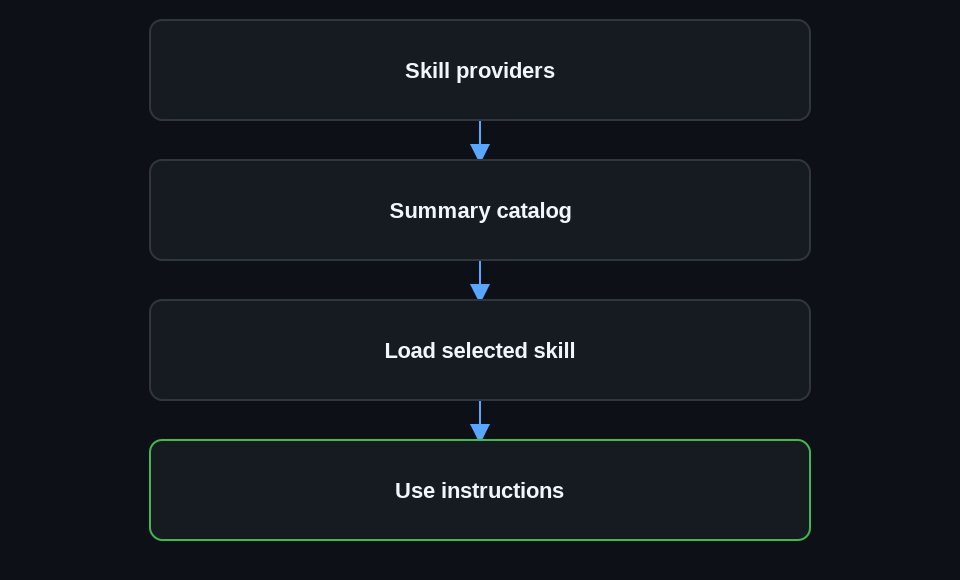
A DeepSeek Harness skill is a discoverable set of optional instructions that an agent can load for a relevant task; discovery exposes summaries first, and the full body is loaded on demand.
DeepSeek Harness: what does a skill provide?
The skills reference describes a registry, providers, and a consumer that offers the model-facing skill tool. A skill can provide instructions and reference resources for a task. It is not itself the execution tool that performs every operation in those instructions. The actual tools and policies available to the agent remain separate.
The registry can combine local, packaged, remote, or other providers. A skill has a kebab-case name and a description used for discovery. The agent's initial model-facing catalog contains names and normalized descriptions, rather than full bodies or absolute paths. This makes a catalog an index for deciding what to load, not a copy of all instructions.
DeepSeek Harness: where are local skills discovered?
The local provider searches the following roots in rank order. The project root is the nearest ancestor containing .git; without one, it uses the current working directory. The provider accepts a directory bundle containing <name>/SKILL.md or a flat <name>.md; it does not recursively discover nested **/SKILL.md files.
| Rank | Source | Root |
|---|---|---|
| 100 | Project DSH | <projectRoot>/.dsh/skills |
| 200 | Project agents | <projectRoot>/.agents/skills |
| 300 | Custom | Config.customSkillDirs |
| 400 | User DSH | <dshHome>/skills |
| 500 | User agents | <agentsHome>/skills |
| 600 | Bundled | Config.bundledSkillDir, when configured |
The local provider skips .system under its user DSH root and does not synthesize built-in system skills. A deployment may add packaged skills through a configured bundled root or a dedicated provider. Within one registry layer, duplicate names resolve by rank, provider order, then local order. Across layers, the nearest scope's entry wins outright. A name alone therefore does not establish which file supplied a skill.
DeepSeek Harness: how does an agent use one?
- The skill consumer discovers a complete view for the session's working directory and scope. When that view is nonempty, it injects a catalog of model-invocable names and descriptions at the first applicable agent step.
- The agent selects a relevant name and calls
skill({ name }). Names must satisfy the documented kebab-case rule. - The tool checks that model invocation is permitted, reloads the complete definition for the calling agent's current directory, and checks policy again.
- The result contains the skill content, resources and instructions. Referenced scripts, references, or assets are resolved through the resource base when needed; loading does not enumerate the directory.
- The agent uses the instructions in the context of the user's task and the tools actually available. Review proposed effects and any requested approval as usual.
This is progressive disclosure: the model sees short routing descriptions first and obtains the selected body later. The full definition is reread on each load rather than cached by the registry. A body-only edit can affect a later load without rewriting earlier results or producing a new catalog message.
DeepSeek Harness: how do skills relate to prompts and visibility?
The system prompt reference describes assembly of scoped prompt sections and context before model steps. The skills reference separately specifies that skill catalogs are durable user-role reminder messages in session history. Do not assume the complete body of every discovered skill is placed in the system prompt. The two mechanisms both influence what the model sees, but have different loading and update behavior.
Model and user invocation controls are independent. A browser session catalog lists user-invocable entries and indicates model-invocation availability; the model-facing catalog includes only model-invocable entries. On a complete later discovery, changed rendered entries produce a replacement catalog. An incomplete discovery preserves the last good model view, so absence or staleness in a transient observation is not proof that a skill was deleted.
What happens when discovery changes?
Providers can report an incomplete observation with usable candidates. The registry does not cache it as an authoritative complete catalog. Later complete snapshots can replace the model-visible catalog when its rendered entries change, including an explicit empty replacement when all previously visible skills disappear. This avoids treating a temporary discovery failure as a definitive deletion. Because the full body is loaded separately, changing only instructions can affect a later load without changing the displayed description. Check both the summary and the loaded content when investigating an unexpected workflow.
A provider's list discovers candidates, while its get loads a selected definition. Discovery and loading can therefore fail at different stages. A name that appeared earlier can become unknown or unavailable by the time the agent tries to load it.
The local provider's priority is also only one part of resolution: a scoped provider may win over a global one with the same name. When the wrong body appears, inspect both scope and origin before changing the name.
DeepSeek Harness: what are the limits and safety boundaries?
A skill is instruction content, not proof that a workflow is correct or safe. Its resources can change, and a provider can be unavailable. Inspect the source and any referenced actions before using instructions that affect files, credentials, or external systems. Tool permissions and approvals still apply. Do not assume a skill is available merely because a file exists under an undiscovered nested directory, or that a summary reveals every instruction in its body.
The reference documents discovery and invocation; it does not promise that the model will select a skill for every relevant task. If the expected skill is absent, check the working directory, root, name, provider, scope, and invocation policy. A failed provider discovery may yield an incomplete view rather than a complete empty catalog.
DeepSeek Harness: what do the terms mean?
- Skill: optional instructions and referenced resources addressed by name.
- Provider: a source that lists candidates and loads full definitions.
- Catalog: the discoverable summaries presented to a consumer.
- Scope: the registry layer view used for a particular agent.
- Resource base: the location used to resolve explicitly referenced skill resources.
Frequently asked questions
Are full skill bodies always in the catalog?
No. The model-facing catalog contains names and descriptions; the selected body is loaded on demand.
Where are project skills found?
The local provider searches project .dsh/skills and .agents/skills among its documented roots.
Are user and model invocation controls identical?
No. They are independent controls.
Sources
Every claim in this article was checked against the sources below. Community discussions are user reports, not official behavior.
This is an independent community article, not official DeepSeek documentation. Listing a plugin in the registry is not a security review.