Publish a DeepSeek Harness Team Plugin Market
A DeepSeek Harness team marketplace is a hosted JSON index of installable bundles. Publish the index and its icons, then have each profile add that index as a source; the index is a discovery catalog, not proof of a plugin's identity or safety.
DeepSeek Harness: What are you publishing?
The marketplace guide defines a market as one UTF-8 JSON index listing DSH bundles, metadata and versions. It can be written by hand or generated, and served with its icon files on a static host. It does not host the plugin packages automatically: each version's source points to an npm package or Git repository. The separate packaging guide explains that a bundle is an npm package with dsh.bundle, which contributes a configuration patch. The marketplace indexes those bundles; the package is the installable artifact.
The Custom plugin markets bundle is experimental. DSH ships no index source, and each source belongs to the current profile. Team members therefore need to enable the feature and add the published index in the profile they actually use. Turning the bundle off removes the Discover tab and the read-only plugin_market tool added to Creator mode.
DeepSeek Harness: What must the index contain?
At the top level, format must be 1, title is required, and plugins lists entries in the market's default order. Each plugin needs a unique npm package name and at least one entry in versions. A version identifies a version string, publication timestamp and source. Optional display metadata includes title, description, icon, author and repository. Localized text may be a string or an object keyed by lowercase language ids; an object must include en.
| Part | Purpose | What to inspect |
|---|---|---|
Index title and plugins | Identifies the market and its catalog | Correct team name, no duplicate package names |
| Plugin metadata | Describes the listed package | Descriptions and links match the package the team intends to list |
| Version source | Identifies where installation gets code | npm package and registry, or Git repository, commit and directory |
engines.dsh | States a version's DSH compatibility when supplied | Range reflects the bundle's supported releases |
icon | Supplies an inline or separate image | Size and URL rules, and the published file |
For a localized title, the guide gives the shape { "en": "Team plugins", "zh": "团队插件" }. A relative icon such as icons/foo.svg resolves relative to the index URL. If the index is at https://market.example/dsh/index.json, that icon is requested under the same directory. An absolute icon on a different origin must use HTTPS. Inline icons can use supported base64 data URLs and are limited to 32 KiB; they increase the index size.
An index is accepted only if all its rules are satisfied. The guide says DSH rejects the whole index on a violation and shows the offending JSON path under Manage index sources…. A single bad version can therefore affect discovery of the whole catalog; validate the published source as a unit rather than assuming valid entries will survive a partial failure.
DeepSeek Harness: How can a team generate and publish it?
The reference generator consumes a plain list of npm package names or HTTPS Git repository URLs, one per line. Blank lines and lines beginning with # are ignored. In a DSH checkout, the documented invocation is:
pnpm --filter @deepseek-ai/dsh-plugin-market-generator start --input plugins.txt --output site/index.json --title "Team plugins"
Paths are relative to the directory where pnpm runs. For npm, the generator lists non-deprecated versions that declare dsh.bundle. For Git, it finds bundle packages on the default branch and examines the documented version tags and the default-branch package versions. Display metadata comes from the highest version. It downloads and reads files without installing packages or running their code, and stores a cache in .plugin-market-cache beside the input list.
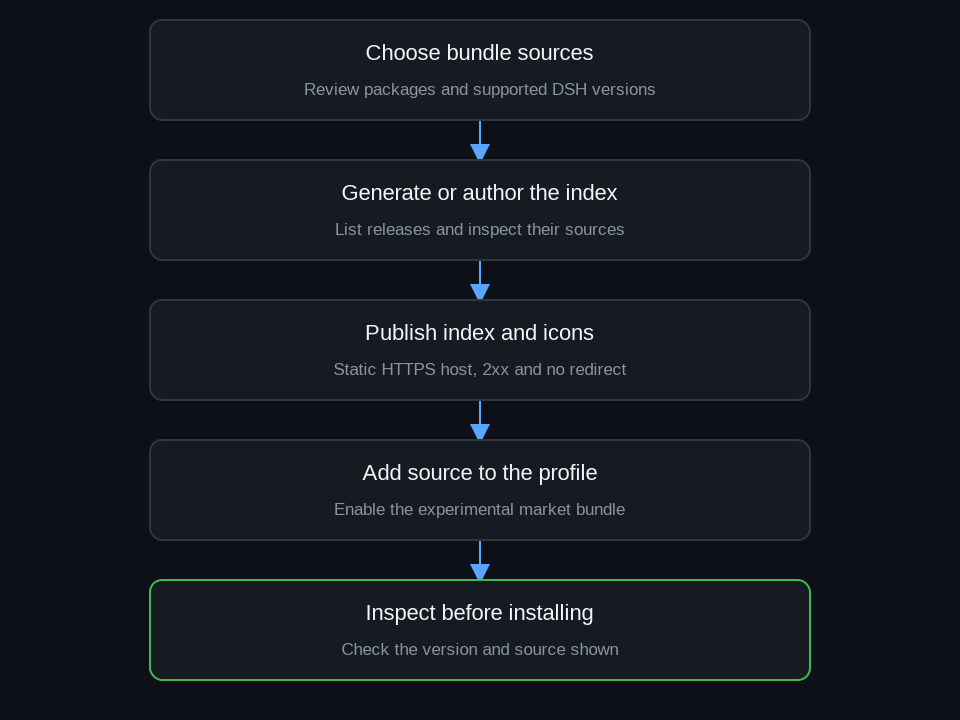
- Inventory the packages and repositories the team intends to list. Verify that the published artifact is a bundle and that its supported DSH range is accurate.
- Prepare the list and run the documented generator, or author the index according to the format reference. Review the resulting versions and their actual sources.
- Publish
index.jsonand the generatedicons/directory together on a static HTTPS host. The server must return a 2xx response without redirects; the default maximum index size is 128 MiB. - In the target profile, open Plugins, choose More beside Experimental plugins, and enable Custom plugin markets. In Discover, choose Add index source and enter the index URL.
- Inspect the source's last error in Manage index sources…, browse representative cards and versions, and compare each installation confirmation to the intended package or Git commit. Record the source URL and profile for teammates.
The generator does not publish files to the host. Likewise, a successful upload is not evidence that a profile can fetch the exact URL without a redirect or that every field meets the index rules. Check the published URL, not only the local JSON.
DeepSeek Harness: How do releases and compatibility reach users?
A market card recommends the highest compatible non-prerelease version, or the highest compatible prerelease if there is no compatible version without a prerelease tag. The Versions list can offer other accepted versions, including older releases and prereleases. The install confirmation shows the chosen source; confirming begins normal plugin installation and its compatibility and registry checks.
The package's own engines.dsh range is checked at installation and profile startup. If it is absent, the packaging guide says DSH checks @deepseek-ai/dsh* peer dependency ranges instead. Publishing an index entry cannot make an incompatible bundle compatible. Maintain the package and its index metadata together, and test the version in a representative profile before asking teammates to adopt it.
An index source URL must use http: or https: and cannot include a username, password or fragment. The guide warns that anyone on an uncontrolled HTTP network path can change the index, including install specifications. HTTPS protects transport against that particular exposure; it does not verify the author or code. For the installer's workflow, see installing from a plugin market.
DeepSeek Harness: What are the limits and safety boundaries?
The market controls its own title, description, icon, author and source claims. DSH checks index format, not the truth of those claims. Review the package or repository and the exact source shown at confirmation; a familiar label or valid JSON is not an endorsement. The market generator's read-only behavior does not apply to a later plugin installation or plugin execution.
Git installation can require a build allowance for a package's prepare script, depending on the package and pnpm version. The packaging guide treats that allowance as permission to execute package code on the installer's machine, outside the agent sandbox. Pin and review the intended source before granting it. A team index should not instruct users to approve unfamiliar code simply to remove an installation error.
The documented index is a static catalog, not a guarantee of availability, a package registry, or an access-control system. The guide does not specify a universal hosting provider, a team-wide automatic enrollment mechanism, or a verification service for market claims. Maintain an accountable owner for the published catalog and a way for users to report wrong or obsolete entries.
DeepSeek Harness: What do the terms mean?
- Bundle: a package declaring a
dsh.bundleconfiguration layer for a profile. - Index source: the URL of the market JSON configured in one profile.
- Version source: the npm or Git location from which an individual listed release is installed.
- Profile: a runnable composition with its own configured market sources.
- Recommended version: the highest compatible release selected by the market's documented prerelease rules.
Frequently asked questions
Does the index host the plugin?
No. It lists version sources pointing to npm packages or Git repositories.
Does DSH include a market source?
No. Add the index source in each profile that should use it.
Does valid JSON verify the plugin?
No. DSH checks the index format, not the truth of marketplace claims.
Sources
Every claim in this article was checked against the sources below. Community discussions are user reports, not official behavior.
This is an independent community article, not official DeepSeek documentation. Listing a plugin in the registry is not a security review.