DeepSeek Harness: Workflows vs. Skills
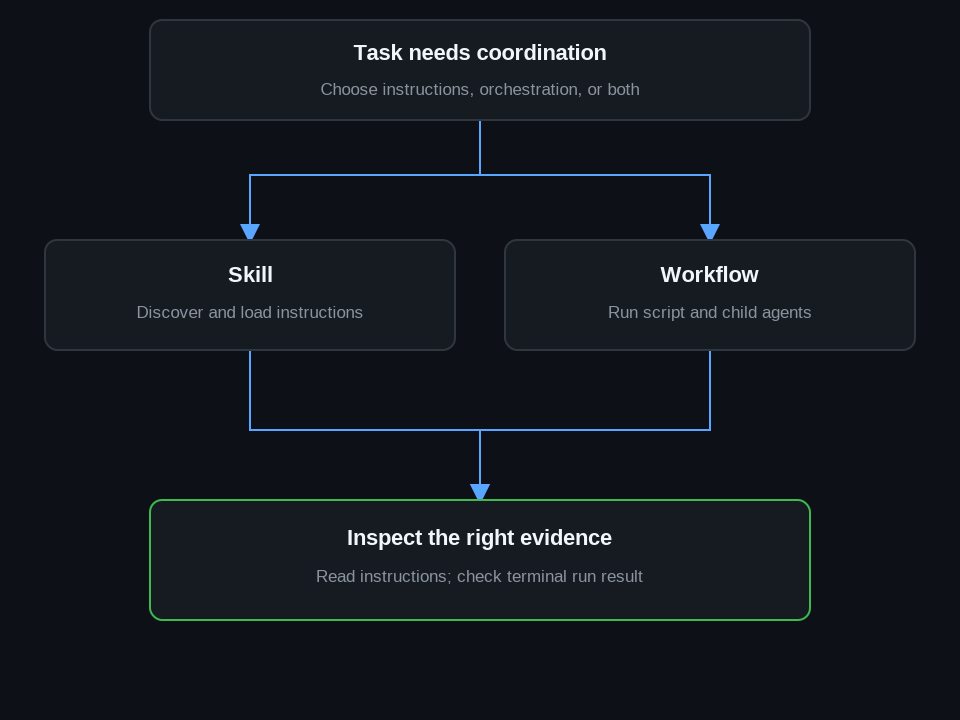
In DeepSeek Harness, a skill supplies instructions an agent can load, while a workflow runs an orchestration script that can start subagents. They solve different coordination problems and neither is a prerequisite for the other.
DeepSeek Harness: which problem does each solve?
The skills reference describes skills as optional instructions supplied by providers and discovered through ctx.skills. A skill can tell an agent how to approach a kind of task; the agent must still interpret and follow those instructions using the capabilities actually available to it. The registry combines providers and a consumer exposes the model-facing skill tool where composed.
The workflow reference instead describes a model-written orchestration script executed by an optional workflow engine. The script can start subagents attributed to the calling parent. The workflow seam is not a mandatory part of the agent loop, and a context has one engine implementation rather than a named engine-provider registry. These are different abstractions even when both are used during the same task.
| Question | Skill | Workflow |
|---|---|---|
| Primary role | Provide reusable instructions | Run an orchestration script |
| Entry point described in the reference | Provider catalog and skill loader | Workflow engine and consumer |
| What starts subagents? | A skill can instruct an agent, but is not itself a run | The workflow script can start child agents |
| Main result to inspect | Loaded instructions and their applicability | Run stop reason and, on completion, return value |
| Availability | Depends on providers, scope and invocation policy | Depends on an engine and consumer being composed |
This table is a distinction in responsibility, not a promise about a particular installation. A team can use instructions without spawning children, or orchestrate children without a specific skill. A skill that recommends delegation is still instruction content; the workflow execution and its actual child runs must be observed separately.
DeepSeek Harness: how does a skill become available?
Providers contribute candidates to ctx.skills. Registration is synchronous; a provider's awaited list() performs discovery, including remote initialization when necessary, and get() loads the complete body of a previously listed candidate. The model session catalog includes the name and description of model-invocable skills, not their body or absolute path. A catalog entry is therefore a routing hint, not the entire instruction set.
The shipped local provider accepts directory bundles with <name>/SKILL.md and flat <name>.md entries. It does not recursively discover arbitrary nested SKILL.md files. Names follow the documented kebab-case rule. Discovery includes project, custom, user and configured bundled roots; exact visibility also depends on the scope layer. The nearest layer wins a duplicate name, while rank, provider order and local order resolve duplicates within a layer.
Model and human invocation controls are separate. A skill present in a provider catalog need not be available to both audiences. Discovery can also be incomplete: a rejected provider listing is logged and omitted from an incomplete observation, while usable candidates from an explicitly incomplete observation do not make that observation cacheable. If a skill seems missing, inspect the applicable scope, invocation policy and provider result rather than assuming that an arbitrary file is automatically loadable.
Loading a skill does not automatically execute every instruction or establish whether its suggested actions are appropriate. Read the complete body and any relevant resources, then check the actual tools and permissions in the environment. The separate skills overview covers the local discovery model in more detail.
DeepSeek Harness: what does a workflow run contain?
The ordinary workflow consumer constructs a start request from the model's script, meta, and optional args, together with the calling agent. meta and args are plain JSON data. The engine validates meta before running the script; it does not evaluate script text to obtain the identity block. The required parent attributes children to the live caller and passes the relevant lineage, depth and working-directory context through the subagent seam.
The identity block requires a kebab-case name and a description; it can also contain whenToUse and phases. Phase declarations and phase() calls are progress vocabulary for observers, not an execution structure. Seeing a phase name is not proof that the engine enforces an ordering or independently completed a corresponding stage.
The run exposes a result whose stopReason is completed, cancelled, or error. The materialized value is meaningful only on completion; non-completed outcomes carry an error. A successful start or a progress event is not the same as a successful final result. The reference also describes specialized consumers that may choose a child provider and lower the total-child limit; those are host-side choices, not settings the script can observe or replace.
DeepSeek Harness: how should I choose and combine them?
- Identify whether the immediate need is reusable guidance or actual orchestration. If the missing piece is a procedure or domain-specific instructions, investigate a skill; if it is coordinating child runs in a script, investigate the workflow capability.
- Check the selected composition. Confirm the relevant skill provider and consumer, or the workflow engine and consumer, are available in the calling context. Both capabilities are optional.
- For a skill, compare the discovered name and description with the task, load its complete body, and assess its instructions against the actual environment. A summary alone does not establish the full procedure.
- For a workflow, inspect the script and its data separately. Check the validated identity, parent and applicable limits; follow the run to its terminal result rather than treating progress as completion.
- If combining them, make the boundary explicit: the skill supplies guidance, while the workflow run supplies observable orchestration. Verify outputs and failures of the actual run before relying on them.
For example, a team may maintain a review procedure as a skill and use a workflow to coordinate separate child reviews. The procedure can describe what evidence each review should consider; it cannot itself guarantee that children were started or that their results were accepted. Conversely, a workflow's child count and result say nothing by themselves about whether its instructions covered every relevant review concern. The example illustrates the division of responsibility, not a built-in review feature.
DeepSeek Harness: how do I interpret failures and progress?
Start by identifying which layer failed. If no skill appears, inspect provider discovery, the viewing scope and model/user invocation controls. If a listed candidate no longer loads, the provider's get() may return no definition. Neither situation alone proves that the workflow engine is unavailable. If a workflow fails, inspect its terminal stop reason and error, rather than treating an earlier skill listing as evidence that the script ran.
Workflow events provide useful but bounded observations. workflow/start indicates the metadata was validated and the body is about to execute. workflow/phase reports progress grouping only. workflow/end accompanies settlement and carries outcome information without the result value; the run result is the place to inspect the returned value. A child that never receives a published run from its provider emits neither member of the documented agent-start/agent-end pair. Do not infer a successful child from the absence of those events.
DeepSeek Harness: what are the limits and safety boundaries?
The shipped workflow PTC provider executes its VM and helpers under the calling session's file policy. That statement describes a boundary in the documented implementation; it is not a guarantee that an arbitrary workflow, plugin, or generated script is safe. Review scripts and child tasks before using them on sensitive files or external systems, and apply the permissions and approvals of the actual deployment.
Skill instructions and resources can also be wrong, outdated or malicious. A matching name, a successful listing, or a completed workflow does not validate their content or the correctness of an output. Check the provider and installed version, and avoid assuming that a workflow can use a particular tool, network endpoint, or child provider unless the composition exposes it. The references describe capabilities and contracts, not a universal configuration for every profile.
DeepSeek Harness: what do the terms mean?
- Skill provider: a source that lists candidates and loads their complete definitions.
- Skill catalog: a discovery view whose model-facing entries need not contain full instructions.
- Workflow engine: the service that runs an orchestration script in a context.
- Parent: the live agent on whose behalf workflow children are started.
- Phase: progress vocabulary for observers, not an execution guarantee.
- Stop reason: the terminal classification of a workflow run.
Frequently asked questions
Does a skill automatically start a workflow?
No. A skill supplies instructions; actual workflow execution depends on an available engine and consumer.
Does a workflow phase enforce an execution stage?
No. Phases are progress vocabulary for observers, not execution structure.
Does a completed workflow prove its output is correct?
No. Completion is a run outcome, not an independent verification of correctness or safety.
Sources
Every claim in this article was checked against the sources below. Community discussions are user reports, not official behavior.
This is an independent community article, not official DeepSeek documentation. Listing a plugin in the registry is not a security review.